
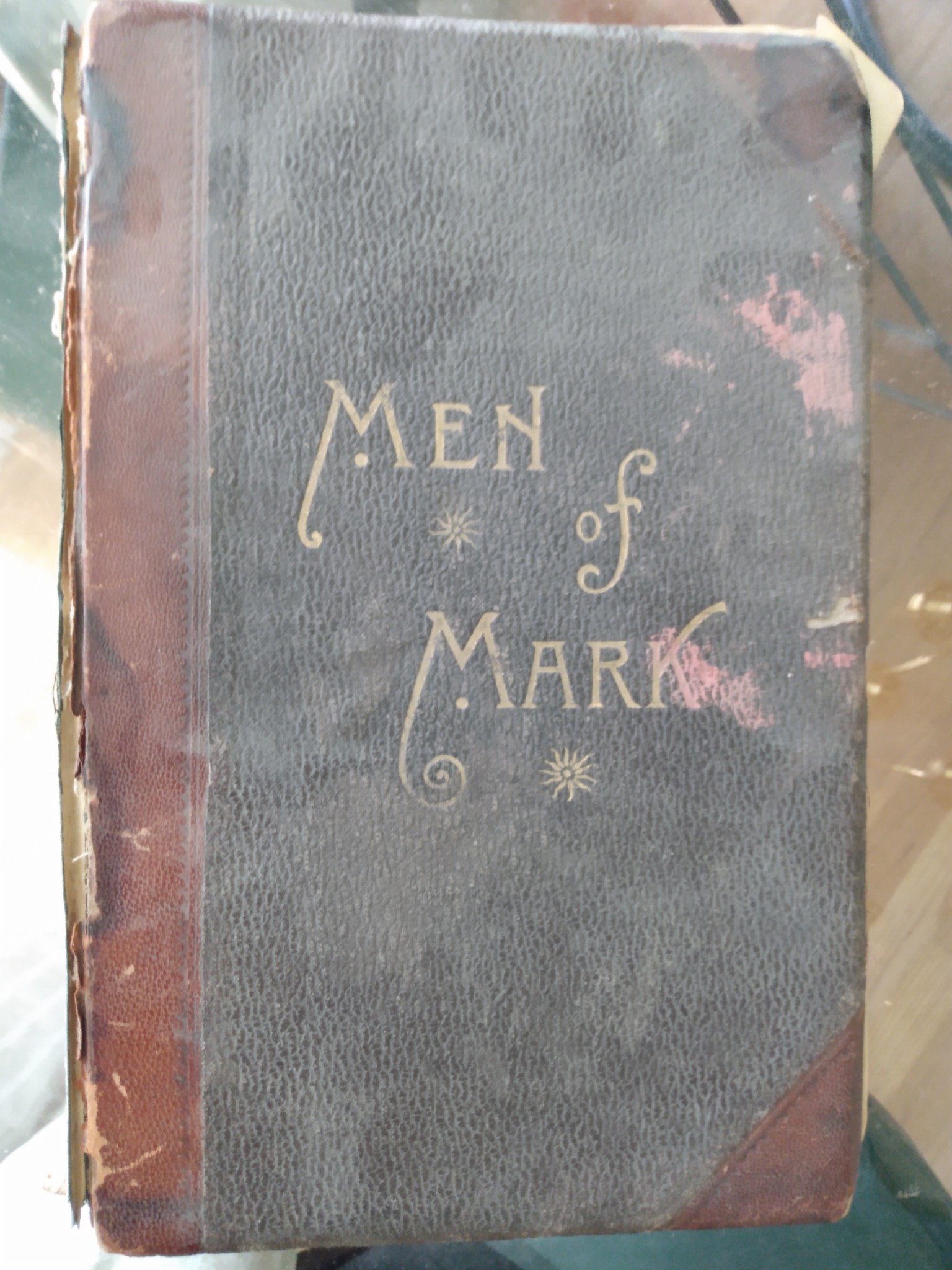
MEN OF MARK

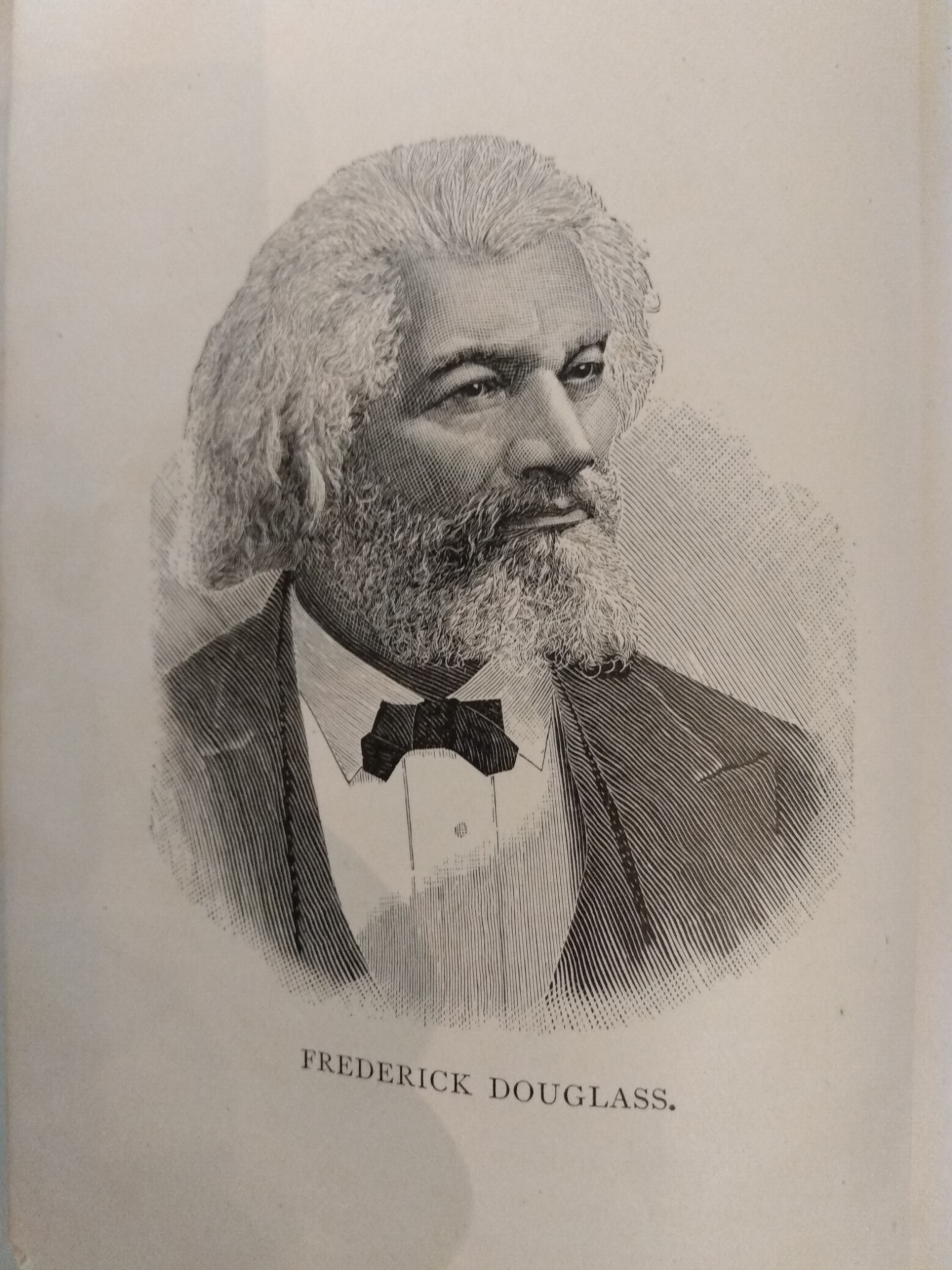
1. HON. FREDERICK DOUGLASS, LL. D.

Magnetic Orator – Anti-slavery Editor – Marshal of the District of Columbia – Recorder of Deeds of the District of Columbia – First Citizen of America – Eminent Patriot and Distinguished Republican.

Who can write the life of this great man and do him justice? His life is an epitome of the efforts of a noble soul to be what God intended, despite the laws, customs and prejudices. That such a soul as Douglass’ could be found with the galling bonds of slavery is the blackest spot in the realm of thought and fact in the whole history of this government. But such a man as he would not remain in slavery, could not do so. Aye! it was impossible to fetter him and keep him there. He was a man. He was not going to remain bound while his legs could carry him off, and, as he facetiously remarked, he prayed for freedom, but when he made his legs pray, then he got free. He shows himself a man of works as well as faith. And these go together. But eulogy is wasted on such a man. His life speaks, and, when he is dead, his orations will keep his memory fresh, and his name will stand side by side with Webster, Sumner and Clay.

Frederick Douglass was born about the year 1817, in Tuckahoe, a barren little district upon the eastern shore of Maryland, best known for the wretchedness, poverty, slovenliness and dissipation of its inhabitants. Of his mother he knew very little, having seen her only a few times in his life, as she was employed on a plantation some distance from the place where he was raised. His master was supposed to be his father.

No man perhaps has had a more varied experience than the subject of this sketch. During his early childhood he was beaten and starved, often fighting with the dogs for the bones that were thrown to them. As he grew older and could work he was given very little to eat, overworked and much beaten. As the boy grew older still, and realized the misery and horror of his surroundings, his very soul revolted, and a determination was formed to be free or to die attempting it.

At the age of ten years he was sent to Baltimore to Mrs. Sophia Auld, as a house servant. She became very much interested in him, and immediately began teaching him his letters. He was very apt, and was soon able to read. The husband of his mistress, finding it out, was very angry and put a stop to it.

This prohibition served only to check the instruction from his mistress, but had no effect on the ambition, the craving for more light, that was within the boy, and the more obstacles he met with the stronger became his determination to overcome them. He carried his spelling book in his bosom and would snatch a minute now and then to pursue his studies. The first money he made he invested in a “Columbian Orator.” In this work he read “The Fanaticism of Liberty” and the “Declaration of Independence.” After reading this book he realized that there was a better life waiting for him, if he would take it, and so he ran away.

He settled in New Bedford with his wife, who, a free woman in the South, being engaged to Douglass before his escape, followed him to New York, where they were married. She was a worthy, affectionate, industrious and invaluable helpmate to the great Douglass. She ever stood side by side with him in all his struggles to establish a home, helped him and encouraged him while he climbed the ladder of knowledge and fame, together with him offered the hand of welcome and a shelter to all who were fortunate enough to escape from bondage and reach their hospitable shelter; and never, while loving mention is made of Frederick Douglass, may the name of his wife “Anna” be forgotten.

In New Bedford he sawed wood, dug cellars, shoveled coal, and did any other work by which he could turn an honest penny, having the incentive that he was working for himself and his family, and that there was no master waiting for his wages. Here several of the children were born.

He began to read the Liberator, for which he subscribed, and other papers, and works of the best authors. He was charmed by Scott’s “Lady of the Lake,” and reading it he adopted the name of “Frederick Douglass.” He began to take an interest in all public matters, often speaking at the gatherings among the colored people. In 1841 he addressed a large convention at Nantucket. After this he was employed as an agent of the American Antislavery Society, which really marks the beginning of his grand struggle for the freedom and elevation of his race. He lectured all through the North, notwithstanding he was in constant danger of being recaptured and sent to the far South as a slave. After a time it was deemed best that he should for a while go to England. Here he met a cordial welcome. John Bright established him in his house, and thus he was brought in contact with the best minds and made acquainted with some of England’s most distinguished men. His relation of the wrongs and sufferings of his enslaved brethren excited their deepest sympathy; and their admiration for his ability was so profound, their wonder so great, that there should be any fear of such a man being returned to slavery, that they immediately subscribed the amount necessary to purchase his freedom, made him a present of his manumission papers, and sent him home to tell his people that

Slaves cannot breathe in England;

If their lungs receive our air, that moment they are free;

They touch our country, and their shackles fall.

Returning to America he settled in Rochester, New York, and established a paper called the North Star, afterwards changed to Fred Douglass’ Paper, also Douglass’ Monthly. These were all published in his own office, and two of his sons were the principal assistants in setting up the work, and attending to the business generally.

There has been a great deal of speculation as to what connection Frederick Douglass had with the John Brown raid. The two great men met, and Brown became acquainted with Douglass’ history. They became fast friends.

They were singularly adapted to each other as co – workers, both being deeply imbued with the belief that it was their duty to devote their lives and means to the cause of emancipation. They lived frugally at home that they might have the more to give. Their families caught their inspiration, and their lives were all influenced by the one motive – power – the cause of freedom. Many men and women who successfully escaped into Canada, and thence to other places, will tell how, after they had been well fed, nourished and made comfortable by the mother, one of Fred Douglass’ boys had carried them across the line and seen them to a place of safety. When other boys were enjoying all the comforts and pleasures their parents could provide for them, Douglass’ sons were made to feel that there was only one path for them to walk in until the great end for which they were working had been attained.

Brown’s first plan was to run slaves off, and in this Douglass heartily joined him; but when he found Brown had decided to attempt the capture of Harper’s Ferry, he went to him at Chambersburg, Pennsylvania, a short time before the raid, and used every argument he could to induce him to change his plans. Brown had enlisted a body of men to accompany him who felt as he felt, that their lives were nothing as weighed against the lives and liberties of so many who were suffering in bondage. His arms and ammunition were ready, his plans were all laid, and to Douglass’ argument he answered: “If we attack Harper’s Ferry, as we have now arranged, the country will be aroused, and the Negroes will see the way clear to liberation. We’ll hold the citizens of the town as hostages, and so holding them can dictate our terms. You, Douglass, should be one of the first to go with us.”

“No, no,” replied the latter, “I can’t agree with you and will not go with you – your attempt can only result in utter ruin to you, and to all those who take part in it, without giving any substantial aid to the men in slavery. Let us rather go on with our first plan of the ‘Underground Railroad’ by which slaves may be run off to the free states. By that means practical results can be obtained. From insurrection nothing can be expected but imprisonment and death.”

“If you think so,” replied Brown, “it is, of course, best that we should part.” He held out his hand. Douglass grasped it. “Goodbye! God bless you!” they exclaimed, almost in the same breath, and then parting forever, were soon lost to each other in the darkness.

It was soon discovered that Douglass and Brown were in sympathy, and that Douglass, besides harboring Brown, had furnished him money to defray expenses, and thus making his safety a matter of great doubt. His friends advised him to leave the country for awhile. They were willing to stand by him, even to fight for him, but felt that it would be wiser to avoid the danger if possible. After much hesitation he was induced to abide by their advice, and the result proved the wisdom of his having done so. He went first to Canada and from there to England. Only a short time after his departure a requisition for his arrest was made by Governor Wise of Virgina. The requisition read as follows:

(Confidential.)

RICHMOND VIRGINIA, November 13, 1859.

To His Excellency, James Buchanan, President of the United States, and to the Honorable Postmaster-General of the United States-

GENTLEMEN: – I have information such as has caused me, upon proper affidavits, to make requisition upon the Executive of Michigan for the delivery up of the person of Frederick Douglass, a Negro man, supposed now to be in Michigan, charged with murder, robbery and inciting servile insurrection in the State of Virginia. My agents for the arrest and reclamation of the person so charged are Benjamin M. Morris and William N. Kelly. The latter has the requisition and will wait on you to the end of obtaining nominal authority as post office agents. They need to be very secretive in this matter, and some pretext of traveling through the dangerous section for the execution of the laws in this behalf, and some protection against obtrusive, unruly or lawless violence. If it be proper so to do, will the Postmaster-General be pleased to give Mr. Kelly for each of these men a permit and authority to act as detectives for the post office department without pay, but to pass and repass without question, delay or hindrance?

Respectfully submitted by your

Obedient Servant,

HENRY A. WISE.

Mr. Douglass did not feel it necessary to hasten his return on account of this interesting document, and so remained abroad till it was safe for him to come home. This adventure did not in the least dampen his ardor in the great cause. Wherever and whenever he could do or say anything for it, he never failed to do so. When the first gun was fired at Sumter, he was among the foremost to insist upon the enrollment of colored soldiers. In 1863 he, with others, succeeded in raising two regiments of colored troops, which were known as Massachusetts regiments. Two of his sons were among the first to enlist. His next move was to obtain the same pay for them that the white soldiers received, and to have them exchanged as prisoners of war; in fact, that there should be no difference made between them and other soldiers. His work did not end with the war. He recognized the fact that a new life had begun for the former slaves; that a great work was to be done for them and with them, and he was ever to be found in the foremost ranks of those who were willing to put their shoulders to the wheel. His means, as well as his time, he largely gave to the cause. He was one of the most indefatigable workers for the passage of the amendments to the Constitution, granting the same rights to all classes of citizens, regardless of race and color. He attended the “Loyalists’ Convention,” held in Philadelphia, in 1867, being elected a delegate from Rochester. Some feared his presence would do more harm than good, knowing how radical he was; but he felt that it was his duty to go, and nothing could change him. It has been conceded that it was due principally to his persistence work in that convention, that resolutions favoring universal suffrage were passed. A little incident in connection with this convention shows the value of his work in that meeting, by disclosing the feeling of the men he had to deal with. As the members assembled proceeded to fall in line, on their way to the place of the meeting, everyone seemed to avoid walking beside a colored delegate. As soon as Theodore Tilton noticed it, he stepped to Douglass’ side, and arm in arm they entered the chamber. This act has made them lifelong friends, and these two are both brotherly in their devoted friendship. In Mr. Douglass’ recent visit to France, he met Mr. Tilton, who resides in Paris, and had a glorious time.

He established the New National Era at Washington, D. C., in 1870. This paper was edited and published principally by him and his sons, and devoted to the cause of the race and the Republican party. In 1872 he took his family to reside in the District of Columbia. In 1871 President Grant appointed him to the Territorial Legislature of the District of Columbia. In 1872 he was chosen one of the Presidential electors-at-large for the State of New York, and was the elector selected to deliver a certified statement of the votes to the president of the Senate.

He was appointed to accompany the commissioners on their trip to Santo Domingo, pending the consideration of the annexation of that island to the United States. President Grant in January, 1877, appointed him a police commissioner for the District of Columbia. In March of the same year President Hayes commissioned him United States marshal for the District of Columbia. President Garfield, in 1881, appointed him recorder of deeds for the District of Columbia. This last position he held till about May, 1886, nearly a year and a half after the ascendancy to the national administration of the Democratic party.

No man has begun where Frederick Douglass did and attained to the same giddy heights of fame. Born in a mere hovel, a creature of accident, with no mother to cherish and nurture him, no kindly hand to point out the good worthy of emulation and the evil to be shunned, no teacher to make smooth the rough and thorny paths leading to knowledge. His only compass was an abiding faith in God, and an innate consciousness of his own ability and power of perseverance.

Harriet Beecher Stowe, in her book entitled ‘Men of Our Times,’ says: “Frederick Douglass had as far to climb to get to the spot where the poorest white boy is born, as that white boy has to climb to be President of the nation, and take rank with kings and judges of the earth.” Again, in the Senate of the United States, in a recent important case under consideration, the following statement formed part of a resolution submitted by that body in reply to the President of the United States: “Without doubt Frederick Douglass is the most distinguished representative of the colored race, not only in this country, but in the world.” To-day he stands the acknowledged peer in intellect, culture and refinement of the greatest men of our age, or any age; in this country, or any country. His name has never been written on the register of any school or college, yet it will ever be written on the pages of all future history, wherever the names of the ablest men of our times appear, side by side with those of the more favored race. His relations with such men as John G. Whittier, Oliver Wendell Holmes, Wendell Phillips, William Loyd Garrison; and such women as Lydia Maria Child, Grace Greenwood, and Harriet Beecher Stowe, have ever been cordial and pleasant. Some men who never graduate from a college have more sense in five minutes than many a conceited graduate who has all his knowledge duly accredited by a sheepskin, but is not the real possessor of an education. The trustees of Howard University honored themselves and their institution, more than they did Mr. Douglass, when they conferred upon him the title of LL. D., and when also they gave him a seat in their board.

Mr. Douglass in ‘His Life,’ written by himself, gives the following account of his visit to his old home:

The first of these events occurred four years ago, when, after a period of more than forty years, I visited and had an interview with Captain Thomas Auld at St. Michaels, Talbot county, Maryland. It will be remembered by those who have followed the thread of my story that St. Michaels was at one time the place of my home and the scene of some of my saddest experiences of slave life, and that I left there, or rather was compelled to leave there, because it was believed that I had written passes for several slaves to enable them to escape from slavery, and that prominent slaveholders in that neighborhood had, for this alleged offense, threatened to shoot me on sight, and to prevent the execution of this threat my master had sent me to Baltimore.

My return, therefore, to this place in peace, among the same people, was strange enough in itself; but that I should, when there, be formally invited by Captain Thomas Auld, then over eighty years old, to come to the side of his dying bed, evidently with a view to a friendly talk over our past relations, was a fact still more strange, and one which, until its occurrence, I could never have thought possible. To me Captain Auld had sustained the relation of master – a relation which I had held in extreme abhorrence, and which for forty years I had denounced in all bitterness of spirit and fierceness of speech. He had struck down my personality, had subjected me to his will, made property of my body and soul, reduced me to a chattel, hired me out to a noted slave breaker to be worked like a beast and flogged into submission; he had taken my hard earnings, sent me to prison, offered me for sale, broken up my Sunday – school, forbidden me to teach my fellow – slaves to read on pain of nine and thirty lashes on my bare back; he had sold my body to his brother Hugh and pocketed the price of my flesh and blood without any apparent disturbance of his conscience. I, on my part, had traveled through the length and breadth of this country and of England, holding up this conduct of his, in common with that of other slaveholders, to the reprobation of all men who would listen to my words. I had made his name and his deeds familiar to the world by my writings in four different languages; yet here we were, after four decades, once more face to face – he on his bed, aged and tremulous, drawing near the sunset of life, and I, his former slave, United States marshal of the District of Columbia, holding his hand and in friendly conversation with him in his sort of final settlement of past differences preparatory to his stepping into his grave, where all distinctions are at an end, and where the great and the small, the slave and his master, are reduced to the same level. Had I been asked in the days of slavery to visit this man, I should have regarded the invitation as one to put fetters on my ankles and handcuffs on my wrists. It would have been an invitation to the auction block and the slave whip. I had no business with this man under the old regime but to keep out of his way. But now that slavery was destroyed, and the slave and the master stood upon equal ground, I was not only willing to meet him but was very glad to do so. The conditions were favorable for remembrance of all his good deeds and generous extenuation of all his evil ones. He was to me no longer a slaveholder either in fact or in spirit, and I regarded him as I did myself, a victim of the circumstances of birth, education, law and custom.

Our courses had been determined for us, not by us. We had both been flung, by powers that did not ask our consent, upon a mighty current of life, which we could neither resist nor control. By this current he was a master, and I a slave; but now our lives were verging towards the point where differences disappeared, where even the constancy of hate breaks down, where the clouds of pride, passion and selfishness vanish before the brightness of Infinite light. At such a time and in such a place, when man is about closing his eyes on this world and ready to step into the eternal unknown, no word of reproach or bitterness should reach him or fall from his lips; and on this occasion there was to this rule no transgression on either side.

As this visit to Captain Auld had been made the subject of mirth by heartless triflers, and regretted as a weakening of my lifelong testimony against slavery by serious minded men, and as the report of it, published in the papers immediately after it occurred, was in some respects defective and colored, it may be proper to state exactly what was said and done at this interview.

It should in the first place be understood that I did not go to St. Michaels upon Captain Auld’s invitation, but upon that of my colored friend, Charles Caldwell; but when once there, Captain Auld sent Mr. Green, a man in constant attendance upon him during his sickness, to tell me that he would be very glad to see me, and wished me to accompany Green to his house, with which request I complied. On reaching the house I was met by Mr. William H. Bruff, a son-in-law of Captain Auld’s, and Mrs. Louisa Bruff, his daughter and was conducted by them immediately to the bedroom of Captain Auld. We addressed each other simultaneously, he calling me “Marshall Douglass,” and I, as I had always called him, “Captain Auld.” Hearing myself called by him “Marshall Douglass,” I instantly broke up the formal nature of the meeting by saying, “Not MARSHALL, but Frederick to you as formerly.” We shook hands cordially, and in the act of doing so he, having been long stricken with palsy, shed tears as men thus afflicted will do when excited by any deep emotion. The sight of him, the changes which time had wrought in him, his tremulous hands constantly in motion, and all the circumstances of his condition affected me deeply, and for a time choked my voice and made me speechless. We both, however, got the better of our feelings and conversed freely about the past.

Though broken by age and palsy, the mind of Captain Auld was remarkably clear and strong. After he had become composed I asked him what he thought of my conduct in running away and going to the North. He hesitated a moment as if to properly formulate his reply, and said: “Frederick, I always knew you were too smart to be a slave, and had I been in your place I should have done as you did.” I said, “Captain Auld, I am glad to hear you say this. I did not run away from YOU, but from SLAVERY; it was not that I loved Caesar less, but Rome more.” I told him that I had made a mistake in my narrative, a copy of which I had sent him, in attributing to him ungrateful and cruel treatment of my grandmother; that I had done so on the supposition that in the division of the property of my old master, Mr. Aaron Anthony, my grandmother had fallen to him, and that he had left her in her old age, when she could be no longer of service to him, to pick up her living in solitude with none to help her; or in other words, had turned her out to die like an old horse. “Ah,” said he, “that was a mistake; I never owned your grandmother; she, in the division of the slaves, was awarded to my brother-in-law, Andrew Anthony; but, ” he added quickly, “I brought her down here and took care of her as long as she lived.” The fact is, that after writing my narrative, describing the condition of my grandmother, Captain Auld’s attention being thus called to it, he rescued her from destitution. I told him that this mistake of mine was corrected as soon as I discovered it, and that I had at no time any wish to do him injustice, and that I regarded both of us as victims of a system. “Oh, I never liked slavery,” he said, “and I meant to emancipate all my slaves when they reached the age of twenty-five years.” I told him I had always been curious to know how old I was, that it had been a serious trouble to me not to know when was my birthday. He said he could not tell me that, but he thought I was born in February, 1818. This date made me one year younger than I had supposed myself, from what was told me by Mistress Lucretia, Captain Auld’s former wife, when I left Lloyd’s for Baltimore in the spring of 1825; she having then said that I was eight, going on nine. I know that it was in the year 1825 that I went to Baltimore, because it was in that year that Mr. James Beacham built a large frigate at the foot of Alliceana street, for one of the South American governments. Judging from this, and from certain events which transpired at Colonel Lloyd’s, such as a boy without any knowledge of books under eight years old would hardly take cognizance of, I am led to believe that Mrs. Lucretia was nearer right as to my age than her husband.

Before I left his bedside, Captain Auld spoke with a cheerful confidence of the great change that awaited him, and felt himself about to depart in peace. Seeing his extreme weakness I did not protract my visit. The whole interview did not last more than twenty minutes, and we parted to meet no more. His death was soon after announced in the papers, and the fact that he had once owned me as a slave was cited as rendering that event noteworthy.

His life has been marked by a purity of purpose from its beginning. He has filled many offices of trust, yet in not one position has he ever betrayed his trust. He has been largely, deeply engaged in politics, yet has been no politician. That is, he understood and practiced none of the tricks of politicians. His work has always been honest and conscientious, because he believed in whatever cause he worked for, and did not, as most of our public men, have an eye to a personal reward. All the recompense he sought was a consciousness of having accomplished some good. Whatever has been given him in the way of office has been unsolicited by him. Some of our public men have wavered in their fidelity to the Republican party, when after long waiting they fail to see a substantial reward laid at their feet; but not so with Mr. Douglass. He believed implicitly in the Republican party and realized that being composed of human beings it might sometimes err; but he would say, “The Republican party is the deck and all outside is the sea.” Another saying of his is, “I would rather be with the Republican party in defeat, than with the Democratic party in victory.” By such expressions may be seen his faithful adherence to what he believed to be right.

He is generous and forgiving, almost to a fault. On the friendliest terms with Lincoln, Grant, Sumner and many of their compeers, his opinions on public matters were always heard with deference and often adopted. His clear, forcible, yet persuasive way of presenting facts, always carry conviction with it.

And now, after a long and well fought battle of seventy years, we find him still erect and strong, bearing gracefully and unassumingly the laurels he has so nobly won. No one who visits him in his beautiful home at Cedar Cottage comes away without being richer by some gem of thought, dropped by the genial host.

A few years ago Fred Douglass married a white lady, who was a clerk in his office while recorder of deeds. This was much objected to by many of his race, but on mature reflection, it has been about decided that he was no slave to take a wife as in slave times on a plantation – according to some master’s wish – but that it was his own business, and he was only responsible to God. He has been invited to the President’s levees and he and his wife shown every mark of consideration. His travel in foreign countries has in no way been embarrassed by this act. If any one thought he was so foolish as to not know what would be said of his marriage, they have mistaken the man. But Douglass did as he thought was right as he understood it. It showed he had the courage to brave popular opinion as he had done on other occasions.

Frederick Douglass enjoys a joke as well as any man I know. I was traveling with him recently from Atlantic City, New Jersey, to Washington, District of Columbia. We had been traveling on the territory of Maryland. Near Harve de Grace, a rather officious white gentleman was particularly attentive to Mr. Douglass, and after introducing himself to the eminent orator stood up and called out to the people in the car: “Gentlemen and ladies, this is Frederick Douglass, the greatest colored man in the United States.” The people flocked around him for an introduction. One white gentleman who was a Marylander, said “Let me see, Mr. Douglass, you ran away from Maryland, did you not, somewhere in this neighborhood, I believe?” “No,” said Mr. Douglass, with that grand air and good humored laugh which is his own property, “Oh, no sir, I did not run away from Maryland, I ran away from slavery.”

There are three great orators in this country, Frederick Douglass, John M. Langston and George W. Williams, the first two are a couplet of as magnificent speakers as ever heard on an American platform; the last is a gifted star ascending the zenith. Douglass and Langston are ripe with age and mellow with experience. The young man is now vigorous and full of strength and handles the less exciting subjects of the day. The older men had the subjects of slavery and reconstruction; two greater themes, can and may never engage our minds in this broad land of swift passing events. They showed their zeal and inspiration against wrong; Williams shows his learning, research, and brilliant oratory.

God grant, when in the course of nature the mantle shall fall from his shoulders, that one may spring up to wear it, to guard it as vigilantly as he has, and as lovingly and carefully protect its folds from pollution.

If the extracts here given should be long, let it be remembered that Mr. Douglass, by length of service, by preeminence in public office, by his standing not only in America, but in the world, is entitled to large space. I want the young people also to declaim these extracts. I am tired of hearing every man’s good works repeated and no Negro’s eloquence chain an audience when, too, there are such elegant specimens.

The following is taken from his great speech in the National Convention of Colored Men held in Louisville, Kentucky, September 25, 1883.

The speaker addressed the greater part of his remarks to the white citizens of the country in the nature of a rebuke for their shortcomings towards the colored race, and said:

Born on American soil, in common with yourselves, deriving our bodies and our minds from its dust; centuries having been passed away since our ancestors were torn from the shores of Africa, we, like yourselves, hold ourselves to be in every sense Americans. Having watered your soil with our tears, enriched it with our blood, performed its roughest labor in time of peace, defended it against enemies in time of war, and having at all times been loyal and true to its highest interests, we deem it no arrogance or presumption to manifest now a common concern with you for its welfare, prosperity, honor and glory.

WHAT THE NEGROES WANT.

Referring to the antagonism experienced in calling the convention, he said:

From the day the call for this convention went forth, the seeming incongruity and contradiction of holding it has been brought to our attention. From one quarter and another, sometimes with argument and sometimes without argument; sometimes with seeming pity for our ignorance, and at other times with fierce censure for our depravity, these questions have met us. With apparent surprise, astonishment and impatience, we have been asked: “What more do the colored people of this country want than they now have, and what more is possible for them?” It is said they were once slaves, they are now free; they were once subjects, they are now sovereigns; they were once outside of all American institutions, they are now inside of all, and a recognized part of the whole American people. Why, then, do they hold colored national conventions, and thus insist upon keeping up the color line between themselves and their white fellow-countrymen?”

Mr. Douglass then proceeded to answer these questions categorically, and took occasion to administer a basting to those of his people who were too mean, servile and cowardly to assert the true dignity of their manhood and their race, and referred the existence of such creatures to the lingering remains of slave caste and oppression.

To the question “Why are we here in this National Convention?” he answered:

Because the voice of a whole people, oppressed by a common injustice, is far more likely to command attention and exert an influence on the public mind than the voice of simple individuals and isolated organizations: because we may thus have a more comprehensive knowledge of the general situation and conceive more clearly and express more fully and wisely the policy it may be necessary for them to pursue. If held for good cause, and by wise, sober and earnest men, the results will be salutary. The objection to a “colored” convention lies more in sound than substance. No reasonable man will ever object to white men holding conventions in their own interest when they are once in our condition and we in theirs: when they are the oppressed and we the oppressors.

In point of fact, however, white men are already in convention against us in various ways, and at many important points; and the practical structure of American life is in convention against us. Human law may know no distinction between men in respect of rights, but human practice may. Examples are painfully abundant. The border men hate the Indians; the Californian, the Chinaman; the Mohametan, the Christian, and vice versa, and in spite of a common nature and the equality framed into law, this hate works injustice, of which each in their own name and under their own color may complain.

The apology for observing the color line in the composition of our State and National conventions is in its necessity, and because we must do this or nothing.

CIVIL RIGHTS OBSTRUCTIONS.

In vindication of the convention and its cause, the speaker continued:

It is our lot to live among a people whose laws, traditions and prejudices have been against us for centuries, and from these they are not yet free. To assume that they are free from these evils, simply because they have changed their laws, is to assume what is utterly unreasonable and contrary to facts. Large bodies move slowly; individuals may be converted on the instant and change the whole course of life; nations never.

Not even the character of a great political organization can be changed by a new platform. It will be the same old snake, though in a new skin. Though we have had war, reconstruction and abolition as a nation, we still linger in the shadow and blight of an extinct institution.

Though the colored man is no longer subject to barter and sale, he is surrounded by an adverse settlement which fetters all his movements. In his downward course he meets with no resistance, but his course upward is resented and resisted at every step of his progress. If he comes in ignorance, rags and wretchedness, he conforms to the popular belief of his character, and in that character he is welcome; but if he shall come as a gentleman, a scholar and a statesman, he is hailed as a contradiction to the national faith concerning his race, and his coming is resented as impudence. In the one case he may provoke contempt and derision, but in the other he is an affront to pride and provokes malice. Let him do what he will, there is at present no escape for him. The color line meets him everywhere, and in a measure, shuts him out from all respectable and profitable trades and callings. In spite of all your religion and laws, he is a rejected man. Not even our churches, whose members profess to follow the despised Nazarine, whose home when on earth was among the lowly and despised, have yet conquered the feeling of color madness; and what is true of our churches is also true of our courts of law. Neither is free from this all-pervading atmosphere of color hate. The one describes the Deity as impartial and “no respecter of persons,” and the other shows the Goddess of Justice as blindfolded, with a sword by her side and scales in her hand held evenly balanced between high and low, rich and poor, white and black, but both are images of American imagination, rather than of American practice. Taking advantage of the general disposition in this country to impute crime to color, white men color their faces to commit crime, and wash off the hated color to escape punishment.

Speaking of lynch law for the black man, he says:

A man accused, surprised, frightened and captured by a motley crowd, dragged with a rope around his neck in midnight darkness to the nearest tree, and told in terms of coarsest profanity to prepare for death, would be more than human if he did not in his terror-stricken appearance more confirm the suspicion of his guilt than the contrary. Worse still; in the presence of such hell-black outrages the pulpit is usually dumb, and the press in the neighborhood is silent, or openly takes sides with the mob. There are occasional cases in which white men are lynched, but one swallow does not make a summer. Every one knows that what is called lynch law is peculiarly the law for colored people and for nobody else.

He next referred to the continuation of Ku-klux outrages, and said generally this condition of things is too flagrant and notorious to require specification of proof. “Thus in all the relations of life and death we are met by the color line. We cannot ignore it if we would, and ought not if we could. It hunts us at midnight, it denies us accommodation in hotels and justice in the courts; excludes our children from schools; refuses our sons the chance to learn trades, and compels us to pursue such labor as will bring us the least reward. While we recognize the color line as a hurtful force – a mountain barrier to our progress, wounding our bleeding feet with its flinty rocks at every step – we do not despair. We are a hopeful people. This convention is a proof of our faith in you, in reason, in truth and justice, and of our belief that prejudice, with all its malign accompaniments, may yet be removed by peaceful means. When this shall come, the color line will only be used as it should be, to distinguish one variety of the human family from another.”

THE REPUBLICAN PARTY’S ATTITUDE.

Our meeting here was opposed by some of our number, because it would disturb the peace of the Republican party. The suggestion came from coward lips and misapprehends the character of that party. If the Republican party cannot stand a demand for justice and fair play, it ought to go down. We were men before that party was born, and our manhood is more sacred than any party can be. Parties were made for men, not men for parties. This hat (pointing to his big white sombrero lying on the table before him), was made for my head; not my head for the hat. (Applause.) If the six million of colored people in this country, armed with the Constitution of the United States, with a million votes of their own to lean upon, and millions of white men at their backs whose hearts are responsive to the claims of humanity, have not sufficient spirit and wisdom to organize and combine to defend themselves from outrage, discrimination and oppression, it will be idle for them to expect that the Republican party or any other political party will organize and combine for them, or care what becomes of them.

The following is taken from an anti-slavery speech delivered many years ago:

A PERTINENT QUESTION.

BY FREDERICK DOUGLASS.

Is it not astonishing that while we are plowing, planting, and reaping, using all kinds of mechanical tools, erecting houses and constructing bridges, building ships, working in metals of brass, iron and copper, silver and gold; that while we are reading, writing and ciphering, acting as clerks, merchants and secretaries, having among us lawyers, doctors, ministers, poets, authors, editors, orators and teachers; that while we are engaged in all manner of enterprises common to other men, digging gold in California, capturing the whale in the Pacific, breeding cattle and sheep on the hillside; living, moving, acting, thinking, planning; living in families as husbands, wives and children; and, above all, confessing and worshipping the Christian’s God, and looking hopefully for immortal life beyond the grave; is it not astonishing, I say, that we are called upon to prove that we are men?

In the Negro, a monthly magazine, published in Boston, Massachusetts, of date August, 1886, under the head of “MISNOMER”

Mr. Douglass wrote as follows:

Allow me to say that what is called the Negro problem seems to me a misnomer. The real problem which this nation has to solve, and the solution of which it will have to answer for in history, were better described as the white man’s problem. Here, as elsewhere, the greater includes the less. What is called the Negro problem is swallowed up by the Caucasian problem. The question is whether the white man can ever be elevated to that plane of justice, humanity and Christian civilization which will permit Negroes, Indians and Chinamen, and other dark colored races to enjoy an equal chance in the race of life. It is not so much whether these races can be made Christians as whether white people can be made Christians. The Negro is few, the white man is many. The Negro is weak, the white man is strong. In the problem of the Negro’s future, the white man is therefore the chief factor. He is the potter; the Negro is the clay. It is for him to say whether the Negro shall become a well rounded, symmetrical man, or be cramped, deformed and dwarfed. A plant deprived of warmth, moisture and sunlight cannot live and grow. And a people deprived of the means of an honest livelihood must wither and die. All I ask for the Negro is fair play. Give him this, and I have no fear for his future. The great mass of the colored people in this country are now, and must continue to be in, the South; and there, if anywhere, they must survive or perish.

It is idle to suppose these people can make any large degree of progress in morals, religion and material conditions, while their persons are unprotected, their rights unsecured, their labor defrauded, and they are kept only a little beyond the starving point.

Of course I rejoice that efforts are being made by benevolent and Christian people at the North in the interest of religion and education; but I cannot conceal from myself that much of this must seem a mockery and a delusion to the colored people there, while they are left at the mercy of anarchy and lawless violence. It is something to give the Negro religion (he could have that in time of slavery): it is more to give him the ballot. It is something to tell him that there is a place for him in the Christian’s heaven; it is more to allow him a peaceful dwelling place in this Christian country.

FREDERICK DOUGLASS.
TO BE CONTINUED: UP NEXT, MEET

W. B. DERRICK
MEN OF MARK

INTRODUCTION CONTINUED – 6

(CONTINUED FROM 7/20/24)

Dr. Simmons, in his modesty, does not claim for this work any special literary excellence, but his aim is simply to embalm in some place the lives of these men for future historians, who may take isolated cases and do justice to each. He also wishes to inspire the youth of the land, giving the many trials through which these men have had to pass, and have them further influenced by the great degree of promotion which has been granted to them. His talents, developed by cultivation, are also enriched by the love of God and man which reaches beyond the boys of today who are trying to be somebody, to the boys of the future, who will inquire into the deeds and achievements of their fathers. As a man, Dr. Simmons is loyal to his convictions, sympathetic, independent, far sighted, therefore a wise counselor, methodical and liberal. He regards money as a trust from God, to be invested in every cause relative to bettering the condition of his fellow men and advancing the cause of Christ. His hand is shut when those who do not want, come to him; but when the really needy and friendless come to him, it is like a strainer full of holes, letting all he possesses pass through. To friends he is faithful; to enemies he shows a steady resistance, but no aggressiveness.

Thus far, I have sketched a few of the prominent phases in the life of the doctor, more in a biographical outline than in analysis of his true worth, reserving for the conclusion a few facts adumbrated in the preceding remarks.

I regard Dr. Simmons as one of the most replete scholars to his age in the country, for all the invincibility that attached to his boyhood and youthful days, enabling him to triumph over every obstacle that confronted him, still incites him to literary research, so that almost every subject within the circle of learning has been pierced by his intellectual prowess. Yet it could not be expected that a man of his age could be the master of every branch, for such exalted attainments only come by years of laborious application, which a young man has not had time to accomplish. The doctor has a large, symmetrically developed head, elevated in the center at the organ of veneration, with a brain texture of the highest type, attesting marvelous powers, when, even in many instances the head is oblong, but infinitely more so when rightly shaped, thus giving the doctor giant powers to use while employed in ferreting out the deep things of science, philosophy and theology, which will, if the doctor lives fifty years, culminate in making him one of the most mighty men of our race upon the globe.

As has been said of liberty, vigilant application is the price of profound scholarship; and this being the charm of his life, nothing but premature death can avert it. Too many of our young men after reaching literary distinction forget the rock from whence they were hewn, and waist their lives in endeavoring to become white, or expend it in worshiping white gods. But this charge cannot be made against the doctor. He is as true to his race as a needle is to the pole, and no stronger evidence is required than the work that will contain these sketches of eminent colored men. The future historian will ponder these pages, glean their contents as he traces the great men of this age, and wonder at the achievements made by them, in the face of so many environments that militated against them. Negro giants now sleeping in the womb of the future, will come forth an Armada that will defy the powers of earth, trample colored prejudice in the dust, write glory, honor and immortality itself upon the brow of black; frown thunders at race distinctions, fire the citadels of manhood discriminations and burn them to the ground; hurl defiance in the face of our defamers and contemners, and with pens of lightning write up the history of our ancestry, and present them before earth and heaven as no one now ever dream.

When that time comes, as it will, unless God ceases to reign, this work of Dr. Simmons’ will form the foot – base of the mighty superstructure that will be reared with chancel, dome, spire and minaret, to the undying worth, merits and fame of the Negro. The abominable heresies set adrift by pseudo – philosophers, pseudo – scientists, and other figureheads as ignorant as they were mean and low, that the Negro race were naturally inferior, and nothing great could ever be evolved from them, will be remembered in the grand hereafter as the overflowing slag or dross which precedes the incandescent rocks dashed from the volcano’s fiery jaws, while hurtled thunders shook the ground as though the gods were in battle arrayed. The Indian represents the past, the white man the present, but the Negro the future. The Indian is old, decayed and worn out; the whites are in the prime of life and vigor; but the Negro is a boy, a youth at school, a mere apprentice, learning his trade. When the white race reaches decrepitude, as races are periodical as well as worlds, the Negro will have reached his prime, and being in possession of all he has and will acquire from the whites, and his own genius and industry to manufacture more and lift him to a higher civilization, he will stand out the wonder of the ages. The earth will tremble beneath his tread, while nature opens her bosom and pours into his lap her richest treasures. With mystic keys he will unlock her coffers, and her very arcana will divulge the secrets which she never whispered before into inquiring ears. Then, if not before, the name of Dr. Simmons will be as familiar to the millions as that of Herodotus, Josephus, Pliny, Plutarch and other historians enshrined in the gratitude of the world. For him the world will have to look largely for a true narrative of the merits of the men who came upon the tapis at the death of our enslavement, and directed affairs while we were in a transitional state, rather while we were bursting the chrysalis that bound our intellectual and moral pinions, and barred our development until we had thrown off the slave forms, slave ears, slave doubts, as to our ability to live by merit and to claim rank among the more favored of earth.

Little as the common observer may regard it, we men who gather up the fragments of our labors, acts, achievements, sayings, songs, oddities, peculiarities, fun, speeches, lectures, poems, war struggles, bravery, degradation and sufferings, and preserve them for the future, now while they are within reach, will stand out as heroes in the day to come. The future orator, statesman, minister, poet, journalist, ethnologist, as well as the historian, will from these gather materials to build towers heaven – reaching that will monument the grandeur of our race, and still grander struggles that lifted them from the barren plains of the contempt of the world, to the majestic heights that we are destined to scale in God’s Providence. To this book, when Dr. Simmons will be numbered with the dead for centuries, will come the men above described, and others in countless scores, to light their torches, inspire their young, encourage the doubtful, animate the faltering and forward the tide of elevation till the last Negro boy and girl on the globe shall be proud of their color, their hair, their origin and their race.

HENRY M. TURNER.

END OF INTRODUCTION. NEXT FROM MEN OF MARK

HON. FREDERICK DOUGLASS, LL. D.

MEN OF MARK

INTRODUCTION CONTINUED – 5

(CONTINUED FROM 7/17/24)

The great National Convention of colored men held at Louisville, September, 1883, enrolled him as a member. His love for the people is shown in the following little incident. While serving as a member of the committee on education and labor, a proposition was made to ask Congress to pass a bill giving the monies which had been left in the treasury from the unclaimed bounties of colored soldiers to the high schools of the South, which would of course have included the denominational, and excluded the public schools. Against this he protested, notwithstanding he was at the head of the denominational school which would have received benefits, on the grounds that the masses should be aided and not the few, and because it was a lack of statesmanship and knowledge of the laws governing the land to ask aid for denominational schools. The committee voted him down solidly, but when the matter was called up in the convention, he took the platform and made a speech so convincing that the chairman, Hon. D. A. Straker, LL. D., of South Carolina, was called upon to change the report, which was done with good grace. At the convention of the Knights of Wise Men, held in Atlanta, Georgia, he took an active part in the deliberations. He has delivered several addresses before the American Baptist Home Mission Society. At the fiftieth anniversary held in New York, May 24, 1872, his orientation, “What are the Colored People Doing?” was much spoken of and published in the Jubilee Volume. He delivered another before the same body, May 26-27, 1885, at Saratoga, and has been invited to address the next meeting, May 29, 1887, at Minneapolis. In 1884, he was appointed by Hon. B. K. Bruce commissioner for the State of Kentucky in the colored department of the World’s Industrial and Cotton Exposition held at New Orleans, Louisiana, and succeeded in giving a splendid representation, thereby reflecting credit on the State. The school over which he presided made a creditable exhibit. The trustee board, in making the annual report to the General Association of Colored Baptists, said:

At the suggestion of our worthy president, who was also the commissioner for Kentucky for the World’s Exposition at New Orleans, an exhibition of our University, of both the literary and industrial work, was sent to the Exposition. To say that the display was complete and satisfactory is but to state it mildly. It has done much to advertise our University, and shows the capacity of our people for both education and industrial pursuits.

In September, 1883, Dr. Simmons called together and organized the Baptist women into a convention, for the purpose of raising money for the educational work of the denomination in the State. The body known as the “Baptist Women’s Educational Convention” has met every year since, and has and is doing a noble work in paying off the indebtedness of the State University.

Were you to ask me Dr. Simmons’ motto, I would say, “God, my race and denomination.” While holding tenaciously his own religious views, he is willing for other men to hold theirs. Among his strongest friends are eminent preachers, scholars and laymen of every denomination in the United States with which colored people are allied. The fact that the Wilberforce University conferred upon him the degree of D. D. is ample evidence of the friendliness existing between him and the brethren of that faith. The faculty of said school ranks with the most eminent men of America, among whom are Reverend B. W. Arnett, D. D., Professor W. S. Scarborough, LL.D., Bishops D. A. Payne, D. D., LL.D., John M. Brown, D.D., D.C.L., and others of like grace and eminence.

Being impressed with the idea that colored Baptists were not doing what they should for the support and influence of their peculiar views, he suggested, through the American Baptist, April 5, 1886, that a convention be held. This suggestion was heartily endorsed by Baptists throughout the United States. He issued the call at their suggestion, and the result was organization of the American National Baptist Convention, which met, August 25, 1886, in St. Louis, Mo., and of which he was unanimously elected president, and chairman of the executive committee. He preached the denominational sermon which was published in the minutes. It was rich in statistics and history, pregnant with the faith as handed down from the Apostles. He concluded by saying:

The work of the colored Baptists is marvelous, aye, stupendous. When we remember our elevation to-day, it is not with undue pride; no! no! no! with thanksgiving and humiliation, with self-abasement and lowliness, and with an earnest prayer for more faith, we lift our eyes to the Great Father of souls and pray His righteous benediction, that we bow our heads because we have been unprofitable servants. Yet it is with astonishment that we have reached such lofty heights, and with remarkable pleasure do we look back upon the depths from which we came. Driven out, Hagar-like, we have, Ishmael-like, still become a people and dwell in the presence of our brethren, and to-day, in figures bright and glowing in the ending of the nineteenth century, we count fully 1,071,000 – every sign of progress. It might be remarked, if we can rise to this point with few learned men, what shall be the result in the next twenty years? Books, papers, magazines and pamphlets shall be as plentiful as the maple leaves in full blown spring.

The Baptist host is like a cube; throw them aside and they always land on an equal side, and you need never despair when in your trials and doubts in your several churches; remember the God of battles is on your side and that the ages have only increased His glory.

His knowledge of the tenets of the denomination with which he is identified is marvelous. In this direction his research has been thorough and extensive as is shown in an article on “Baptism” published in the A. M. E. Review, October, 1886, in reply to Rev. B. W. Williams.

As an orator Dr. Simmons is pleasing to his audience. A quick thinker, and possessing a rich and ready flow of choice language, a figure that can be seen, and a voice that can be heard at a distance. At times, in the heat of debate, the whole grandeur of his soul is transfused into his countenance; and his hearers are electrified as only true eloquence can electrify.

He was invited to address the students of three different colleges in one year. At Selma University, May 28, 1885, his subject was “True Manliness.” The Baptist Pioneer commented as follows:

For nearly an hour and a half the speaker held the large audience spellbound. He was eloquent and inspiring. Rarely have we listened to a more practical oration. At times the audience was convulsed with laughter at the wit, and then immediately made to reflect under the solid words of wisdom which fell from the speaker’s lips.

His address before the Berea College students, subject “The Great Text-Book of the Ages,” received much comment. June 18, 1885, after delivering an oration before the Wilberforce Literary Society, subject “Leaders and Followers,” he had conferred on him the degree of D.D., by that venerable institution. In 1881, he had received the degree of A. M., from Howard University. During the educational movement in Kentucky, in 1885, I think, Dr. Simmons delivered a speech before the Inter-State Educational Convention, which was held in the white Baptist church, subject “The Education of the Negro Race.” In this convention were found the most eminent educators, State superintendents and the most noted thinkers in America. Favorable criticism was made by the New York Journal of Education, the Courier-Journal of Louisville, and other State papers.

He delivered an oration at the Lexington Emancipation celebration, January 1, 1887. Urging the hearers to greater efforts, he said:

The warm blood of the Negro that haunts the channels of his veins with ancient Egyptian and Ethiopian fires has been tempered in the climate of the South and reduced to that proportion which robs it of its sluggishness, subdues it of wild passion and holds it by reason, while the trials of the past have been the friction that brightens, the winds that toughen, and the frosts that ripen. No great song, or poem, or book, or invention has yet seen birth south of the “Mason and Dixon Line.” It has been reserved for us. The only American music was born on the plantations and wrung from aching hearts as wine from the luscious grape. It has touched the heart of the learned and engaged the attention of the scientific musician. As the Indian faded in the North, before the white man, so the white man of the South must yield to us, without, however, a bloody conflict. We shall gather wealth, learning and manhood and occupy the land. This is the asylum of the world; and the tramp of hurrying nations warns us that this is the “Valley of Decision.” On this soil are settled the great questions of the earth. Already the march of empire has bathed its weary feet in the Pacific, and with the exception of watery waste has arrived at its home, and it is possible that He who made all nations of one blood, will here in our land, marry and intermarry, and reduce this conglomerate mass to one distinct nationality, with all the blood made one, and the highest type of consecrated manhood being realized, reduced back to the Adamic color through us; or He may out of the aggregate develop each to its highest type, and let them live to the end of time, carrying out His divine plans, and unerringly accomplishing His decrees. Here in this new South the Negro shall shine in the constellation of the nations, and by his words and deeds hand down to unborn ages the glittering pages of our history. We shall in some prominent way mount the ladder of difficulties, scale the cliff of prejudices and hide our heads among the stars.

TO BE CONTINUED…

MEN OF MARK

INTRODUCTION CONTINUED – 4

(CONTINUED FROM 7/15/24)

At the meeting of the Colored Press convention in St. Louis, Missouri, July 13, 1883, he was nominated for its president, but was beaten by Hon. W. A. Pledger of Georgia by one vote. When said convention met in Richmond, Virgina, July 8, 1885, he was made chairman of the executive committee and at the next meeting, August 3, 1886, Atlantic City, New Jersey, he was elected president by a majority of four over Mr. T. T. Fortune, editor of The Freeman.

Dr. Simmons is very much interested in the education of the hand. He has written a pamphlet on “Industrial Education” which has had a wide circulation. A sample of it will be seen below.

If the industrial craze be not watched, our literary institutions will be turned into workshops and our scholars into servants and journeymen. Keep the literary and industrial apart. Let the former be stamped deeply so it will not be mistaken. We need scholars. All men are not workers in the trades, and never will be. If we cripple the schools established, by diverting them largely from their original plan, we shall have no lawyers, doctors, professors, authors, etc. And again, the money in the schools will be divided and neither end will be reached; we will be like clowns trying to ride two horses, and as they get wider apart, we drop in a ditch, and our horses run away from us and break their own necks. Keep these schools apart, and attempt not the task of grinding scholars out of industrial, nor finished workmen from literary schools. Each has a legitimate sphere and let each stick to it. In the colleges, universities and higher schools of the South, not less than a thousand white men are teaching our youth; it is not intended that they will do so forever. I would, therefore, prepare the professors to take their places in the same manner that they were prepared – in literary institutions. In plainer words, let the student be free from industrial trade work when he has made certain grades in his classes. We want good workmen and good scholars, not deluded smatterers in either department. Gingerbread work, fiddling with tools, frittering away time, is not seriously making a mechanic. Industrial work as a sentiment must be crystallized into a profitable reality.

Hence, this feeble effort in Southern schools will only be the means of deceiving many into the notion that they are “workmen,” when they are only botches, and will furnish another poor class of mechanics to supplement a class of which we now complain. It would be wiser to spend ten thousand dollars on a single school per year, and make a first class industrial department, than two thousand dollars on each of five schools. Many will learn to do things for which they can give no reason.

The people, the masses, the boys, the girls, the rank and file, must be taken through a thorough course and made master of a trade. I said this school was needed as a corrective; that is, to teach the dignity of labor. They must learn the gospel of manual labor; not simply as a means of bread and butter, but an honorable calling and duty. Let the buzz of the saw, the ring of the hammer, the whisle of the engine, the spinning of the wheel, the low of the ox, the bleating of the lamb, the crow of the rooster, all be music and inspiration to the rising race. Labor is honorable, but it is fast becoming unfashionable for the colored boy or girl to seek manual labor, and rather than work, many become loafers, dissipates and wrecks. Let us start a current large enough to meet the mental tide and mingling, find the happy medium. Parents must give their children trades. Teachers and preachers must see to this matter.

This school should have a large farm attached, where agriculture in every form should be taught, and by means of which living could be made cheap to poor students. To sum up the words of another, here in this school, the farmer should be educated in science, elementary engineering, mechanics and agriculture; the miner, mineralogy, geology, chemistry, and his own work; the merchant in geography, history, foreign language, political economy and laws; the machinist must master all the known powers of material nature – heat and cold, weight and impulse; matter in all conditions – liquid, solid and gaseous, standing or running, condensed or rare, adamantine or plastic – all must be seen through and comprehended by the master of modern mechanics. Architects, engineers, teachers and all classes of workers require a technical education.

I mean to take the female along too. They must be taught domestic economy, household ethics, home architecture, cookery, telegraphy, photography, printing, editorial work, dressmaking, tailoring, knitting, fancy work, nursing, dairying, horticulture, apiaculture, sericulture, poultry raising, stenography, type-writing, practical designs, painting, repousse work, etc., etc., for if men must make money, the women must know best how to save it, or what is better, help to get it. A saving wife is worth her weight in gold and earns her own board and is entitled to have her washing done from home.

Before I leave this subject, let me say that it may prove the best thing after all that our youth cannot get into the workshops and factories as readily as white youths. The latter class have the blessings of good homes and the amenities of a social life beyond that of a colored child. Every library, lecture hall and art gallery is open, and the finest music, sculpture, books, magazines and journals fall as thick around them as autumn leaves. But our youths need to have the moral training which comes from the school – room as well as the skill that comes from the workshop. They need practical drill in habits of industry, care in business, punctuality in dealing with the world, and, in fact, they need the moral bracing up that makes good citizens and square business men and women. Perhaps Providence has so hedged us that out of trials and darkness may come pleasure and light. So now we are driven to do perhaps the best thing for our race by putting our children where head, hand, eye, ear, and in fact the whole man, must be trained.

TO BE CONTINUED….

MEN OF MARK

INTRODUCTION CONTINUED – 3

CONTINUED FROM 7/13/24

As an educator, he has likely no superiors. Discarding specialism in education, he claims that ideal manhood and womanhood cannot be narrowed down to any one sphere of action, but that the whole being – every faculty with which we are endowed – must receive proper development. No boy or girl comes under his influence without feeling a desire to become useful and great. He infuses inspiration into the least ambitious. He has a knack of “drawing out” all there is within. No flower within his reach “wastes its sweetness on the desert air.” If there are elements of usefulness in those around him, he trains and utilizes them. As a president, his executive ability is excellent. Students admire, respect and stand in awe of him; his teachers are proud of him, trust his judgement and abide by his decisions. For poor students he has the tenderest sympathy, especially for those who most desire an education and struggle hardest for it. He rewards those who are faithful in discharge of duty, and for those who accomplish something he has words of cheer, but for idlers nothing.

September 29, 1882, he was elected editor of the American Baptist, and at this time is President of the American Baptist Company. As an editor, Dr. Simmons brings before the public every live issue of the day. His editorials are racy, versatile and logical. He contends for rights and cries down wrongs. He is extensively copied, and has the personal respect of every editor and prominent man in the country. A man of forcible character and deep convictions must reveal himself in his writings, and the subject of this article is such a man. His pen pictures are characterized by a rugged strength which takes hold of the reader and fixes the thought in memory more than by elaboration and flourishes which soothe and please, but pass from the mind as water through the seive. In regard to the duty of colored citizens to existing parties he believes “that committed as both parties are to the pernicious doctrine of State Rights, colored people should pay less attention to national politics than to State affairs.” He says:

”The days are slipping by and our children are growing into manhood and womanhood – we are fast passing away. Shall we live deluded with the hope that the general government will bring to us a panacea for all our ills? No; we must court the favors of the people of the State. We must be for progress wherever found. We must act wisely. Indeed the Republican party could not, if it would, help us. They are debarred by statutes, and sentiments, stronger than statutes. Let us study State interests, its schools and its development in every direction. Let us cast our votes for liberal men who will help us. We cannot expect those against whom we vote to do so. Take Kentucky; who has secured all the school advantages for the colored race? Why, the colored people themselves. The Republican party did not do it – not a bit of it. The white men of the party and their children were all right. When did they offer to make a special fight for us? Never. When, then, did we secure a change of the forty-eight per capita tax to an equalization of the tax for all children alike? By petition of our own and by favor of Democrats, even when put to a popular vote, and by the act of a Democratic legislature. Is it not queer, too, that we never thought to demand of our party that they made the fight for us? The answer is, the colored man is such a slave to party that his blind obedience has befogged his reason so that he has fought the white man’s battles, secured office for him, and fought for his own rights unaided in “Negro Conventions.” White men would have made a broad open fight and demanded the Negro votes. After the convention was over the Negroes would petition the very legislature members whom they had fought and voted against in every county. Negroes attempt to do in convention what they ought to do with their votes, and are driven to it by the policy of the Republican party in the South. We should change this thing.”

Dr. Simmons activities are prominently identified with the most important affairs of the race. Several years he has been chairman of the executive committee of the “State Convention of Colored Men of Kentucky.” At the meeting in Lexington, November 26, 1875, he was re-elected. The call of the said meeting, a document enumerating in a few words, the long catalogue of injustices practiced upon the colored citizens of the State, shows a high degree of statesmanship. It begins thus:

FELLOW-CITIZENS: – When a free people, living in a body politic, feel that the laws are unjustly administered to them; that discriminations are openly made; that various subterfuges and legal technicalities are constantly used to deprive them of the enjoyment of those rights and immunities belonging to the humblest citizen; when the courts become no refuge for the outraged, and when a sentiment is not found sufficient to do them justice, it becomes their bounden duty to protest against such a state of affairs. To do less than vigorously and earnestly enter our protest is to cringe like hounds before masters, and to show that we are not fit for freedom. We are robbed by some of the railroad companies who take our first-class fares and then we are driven into smoking cars, and, if we demur, are cursed and roughly handled. Our women have been beaten by brutal brakemen, and in many cases left to ride on the platforms at the risk of life and limb.

We are tried in courts controlled entirely by white men, and no colored man sits on a Kentucky jury. This seems no mere accident, but a determined effort to exclude us from fair trials and put us at the mercy of our enemies, from the judge down to the vilest suborned witness.

When charged with grave offenses, the jail is mobbed, and the accused taken out and hanged; and out of the hundreds of such cases since the war, not a single high-handed murderer has ever been brought before a court to answer. Colored men have been deliberately murdered, and few if any murderers have been punished by the law. Indecent haste to free the criminal in such cases has made the trial a farce too ridiculous to be called more than a puppet show.

The penitentiary is full of our race, who are sent there by wicked and malicious persecutors, and unjust sentences dealt out by judges, who deem a colored criminal fit only for the severest and longest sentences for trivial offenses.

In all departments of the State we are systematically deprived of recognition, except in menial positions. In our metropolitan city, and even cities of lesser note, we are not considered in the appointments in fire companies, police force, notary public, etc. In fact, we are the ruled class and have no share in the government.

Dr. Simmons was chairman of the committee appointed by the convention to lay before the Legislature the grievances of the 271,481 colored citizens. His speech on this occasion was a masterpiece. Says the SoldiersReunion, a paper published at Lexington:

The speech of Rev. W. J. Simmons, D. D., before the Kentucky Legislature, was one of the ablest efforts ever made in the interests of the colored people. They (the Legislature) have ordered two thousand copies printed.

Said he:

Only the history of the two races in our beautiful country could give birth to such a scene as this. That we, born Americans, finding distinctions in law, should be driven to appeal to a portion of the same body politic for rights and equalities; and though American sovereigns ourselves, because too weak, bend the suppliant knee, craving that we might be given that which appears rightly ours without contest. We feel some pride, and are consequently jealous of the good name of the State and of the United States. We also feel humiliated that a foreigner who has never felled a tree, built a cabin, or laid a line of railway, seems more welcome to this shore, and is accorded every facility for himself and children to make the most of themselves, even BEFORE NATURALIZATION; while we, seeing them happy in a new-found asylum, and knowing you from our youth up – our mothers washed your linen and nursed you, our fathers made the soil feed you, and kept the fire burning in your grate – are compelled to beg, in the zenith hour of 1886, your favors. Two generations are before you; the one born in the cradle of slavery, the other born in the cradle of liberty; the one saw the light mid the discussions of your fathers; the other mingled their infant’s voice with the retreating sound of the cannon. We belong to the South – the “New South.” Your own progress in the questions of human liberty and our own thirst for draughts from higher fountains, and, indeed, in obedience to the demands of our constituents, we venture to lay before you in a manly, honorable way, the complaints of 271,481 as true hearted Kentuckians as ever came from the loin of the bravest, truest and most honored of women, sired by the most distinguished fathers. As Kentuckians we meet you with the feelings and aspirations, common and peculiar to those born and surrounded by the greatness of your history, the fertility of your soil, the nobility of your men and the beauty of your women. We come, plain of speech, in order to prove that we are men of judgement, meeting men who are really desirous of knowing our wants.

NOTES: It is clear to me that the written word in the 1800’s was somewhat different than the way we utilize words, periods, semicolons, etc. the English language. To honor the Men of Mark, who wrote these pages, I’m not changing anything they wrote. The way you are reading this AWESOME WORK – Is the way it was written.

TO BE CONTINUED.

MEN OF MARK

INTRODUCTION CONTINUED – 2

(CONTINUED FROM 7/10/24)

His army life was not uneventful; he took part in battles around Petersburg, Hatches Run, Appomattox Court House, and was present at the surrender of Lee, the crises out of which our own happier cycle of years has been evolved. He was discharged September 13, 1865, and in 1866 and 1867 worked as journeyman at his trade for Dr. William H. Longfellow, a colored dentist of Philadelphia, after which he returned to Dr. DeLange.

He was converted in 1867 and joined the white Baptist church in Bordentown, pastored by Rev. J. W. Custis, a brilliant man, under whose influence about one hundred and fifty had joined the church that spring.

Although the only colored man in the church, he was treated with much kindness; and when his call to the Gospel ministry was made known, they rallied to his support, defraying his school expenses three years. The New Jersey State Educational Society aided him to attend Madison University of New York, from which he graduated in 1868, taking the academic course. Both students and teachers were his warm friends and are today. The dark skinned youth, though alone, never felt the sting of injustice at their hands. September, 1868, found him matriculated at Rochester University, having been led to make the change by an offer of additional aid by laboring in a small Baptist church in Rochester, and because there he found colored people among whom he could associate and do missionary work. At this early date we see cropping out the love for the race which in after years became one of the ruling passions of his life.

One pleasant year slipped by, and the freshman year completed, when his eyes became seriously affected. The trouble was brought on by continuous night study of Greek during his academic year. This prevented school attendance until the year 1871 when he entered Howard University, Washington, District of Columbia, and graduated as an A. B. in 1873. His graduating oration treating of the Darwinian theory, a subject then very popular in literary circles, attracted much attention and newspaper comments. Extracts were printed in a paper in England devoted to science and literature.

At many periods, his school life was a sequel to the days of deprivation of childhood. Time and again he would be forced to stay indoors while having his only shirt laundried. Poor shoes and patched clothes were the rule, not the exception. During his entire course he did not have a whole suit until reaching the senior year. Once he ate cheese and crackers three weeks. During the senior year, September, 1872, to June, 1873, he walked seven miles a day, and taught school; came home and drilled the cadet company from four to five; recited at night, and graduated with the salutatory of the class. That was a happy day; by frugality he had saved three hundred dollars. Commencement day for him ended many deprivations and sacrifices in one sense. Both have come since, but of a different character and easier to bear. In the world one can find means of replenishing his purse, and many opportunities of changing his circumstances; but with a student it is different. He must in a degree be stationary, and cannot move around for the purpose of getting benefits.

During these years his mother lavished on him the devotion and pride of a loving heart. She washed, ironed and labored in other ways to help him. In this she was greatly assisted by one Bunting Hankins and his devoted wife of Bordentown, New Jersey, in whose family she labored. General O. O. Howard, president of Howard University, and General E. Whittlesey, dean of the college department, showed him many kindnesses during and after college days. While a student, he showed such aptness to teach in conducting a school at a place called Bunker’s Hill, rebuilding it almost from nothing, that the school-board promoted him to the principalship of a much larger building, with several hundred scholars. This was the Hillsdale Public school, District of Columbia. Here he boarded in the house of Hon. Solomon G. Brown, one of the ablest scientists in this country.

Immediately after graduating, he took Horace Greeley’s advice, and went west, to Arkansas, with the idea of making it his home; was examined and secured a State certificate from the Honorable Superintendent of Education, J. C. Corbin, but soon returned to Washington and taught at Hillsdale until June, 1874.

After marrying Josephine A., the daughter of John and Caroline Silence, in Washington, District of Columbia, August 25, 1874, he went south. By this union they have had the following children: Josephine Lavinia, William Johnson, Maud Marie, Amanda Moss, Mary Beatrice, John Thomas and Gussie Lewis. Desiring to better his financial condition he went to Florida, September, 1874, and invested in lands and oranges, but the investment did not prove a paying one. While in Ocala (in 1879) he was ordained a deacon, and was licensed to preach without asking for it. Pastored at a small station a year before ordination, after which time, he was ordained the night before leaving the State.

He was principal of Howard Academy, deputy county clerk and county commissioner. Here, too, his political tendencies received an impetus. He was chairman of the county campaign committee, and a member of the district congressional committee. Stumped the county for Hayes and Wheeler, and when it is remembered that the state went only 147 majority for Hayes, it is quite a material thing that the county in which he lived raised its quota from 525 Republican majority to 986. After this he returned to Washington and taught public school until 1879, when he left to accept the pastorate of the First Baptist church, Lexington, Kentucky. To do great work, God raises up great men.

September, 1880, he was called to the presidency of the Normal and Theological institution (as it was then called), a school conducted under the auspices of the General Association of Colored Baptists of Kentucky. At that time the school had but thirteen pupils, two teachers and an empty treasury. Says the Bowling Green Watchmen, a State paper edited by Rev. Eugene Evans:

Few men of Professor Simmons’ ability and standing would have been willing to risk their future in an enterprise like the Normal and Theological Institution; an enterprise without capital and but a few friends. But it can be truly said of Professor Simmons, that he has proven himself master of the situation. The school had been talked of for nearly twenty years’ but no one ever dreamed of its being a possibility. When he was elected president, every cloud vanished, and the sunshine of success could be seen on every side. Some of his students already rank among the foremost preachers, teachers and orators of the State.

To Be Continued.

MEN OF MARK

INTRODUCTION.

ACCOMPANIED BY A SKETCH OF THE LIFE OF REV. W.J. SIMMONS, A.B., A.M., D.D.

It is a historic fact that Virginia soil has been rife with Presidents, but truly South Carolina has given to the world more men of note than any other State in the Union. In Charleston, South Carolina, June 29, 1849, Edward and Esther Simmons, two slaves, added to their fortune the subject of this sketch, who though born in poverty, shrouded by obscurity, was destined to make for himself a name honored among men. At an early period in his life, interested parties hurried the mother with three small children northward, without the protection of a husband and father, to begin a long siege with poverty. When the steamer landed at Philadelphia they were met by an uncle, Alexander Tardiff, who left the south some time before. This uncle, a shoemaker by trade, displayed the virtues of a generous nature in caring for the mother, William, Emeline, and Anna as well as he could, with prejudice to fight. These were days of hardships and anxieties so keen for the little family that even now the survivors speak of them in hushed tones and with misty eyes. While in Philadelphia they were harassed by slave traders who seemed determined to burrow them out of their hiding place. At this time disease laid his hand upon them.

Disasters come not singly;

But as if they watched and waited,

Scanning one another’s motions.

When the first descends, the others

Follow, follow, gathering flock-wise

Round their victim, sick and wounded,

First a shadow, then a sorrow.

Till the air is dark with anguish.

Huddled together in the garret of the three-story brick house where they lived, stricken with the small-pox, almost destitute of food, and fearing to call in medical attendance lest by attracting attention they would be carried back into slavery; while death stared them in the face, fugitive slave hunters rapped at the door of the front room which the uncle used as a workshop. These beasts in human flesh, after many inquiries and cross-questionings were so misled by the shrewd uncle that they went away. Shortly after, the uncle finding it impossible to earn a living at his trade, decided to go to sea. The family was left at Roxbury, Pennsylvania. Here for two years the faithful mother toiled morning, noon and night, at washing and other hard work to support the children and keep them together. At the expiration of this time the uncle returned and carried them to Chester, Pennsylvania, where he was able to do a good business; but the same old trouble arose. The slave traders were on their track again! The family was smuggled away to Philadelphia and remained long enough for the uncle to secure employment, by answering an advertisement inserted in the papers by George and Arthur Stowell, Bordentown, New Jersey, for a journeyman shoemaker. At this place it was a daily contest with poverty and a struggle for bread; however, the children were kept together, and none were ever hired out. During the entire boyhood of William, so hard pressed were they because of sickness, dull seasons of work and other difficulties, that never a toy, so dear to childhood, brightened his life; and for days and weeks, milk and mush was his only food. He never attended a public school in his whole school life. The uncle having attended school in Charleston under D.A. Payne, now Bishop Payne of the A.M.E Church, was a fair scholar and undertook the education of the children, laying a foundation so broad and exact, that in after years college studies for the boy were comparatively easy.

William was by no means a good “Sabbath-keeping boy” such as we read of in books. He gave considerable trouble at home and abroad. In 1862 he was apprenticed to Dr. Leo H. DeLange, a dentist in Bordentown, New Jersey. So far as giving him necessary instruction, the doctor was kind to him. William had learned so thoroughly all there was to be learned in the profession, that when the doctor was absent he was able to do a large part of the work. Though often rebuffed by white patients, he operated on some of the best families in the city. He endeavored to enter a dental college in Philadelphia, and was refused largely on account of color. Unwilling to enter the profession without a thorough knowledge, such as could be given only in a training school, he decided to abandon the profession, but remained with the doctor until September 16, 1864, at which time, becoming disgusted at the treatment received at the hands of the doctor, he ran away and enlisted in the Forty-first United States colored troops.

TO BE CONTINUED.

MEN of MARK

My husband inherited this book from his grandfather, who was born in 1885. When I first laid eyes on it, I wept. This precious book, gift, gives insight into the lives of Black people in early, America.

PREFACE.

To PRESUME to multiply books in this day of excellent writers and learned book-makers is a rash thing perhaps for a novice. It may even be a presumption that shall be met by the production itself being driven from the market by the keen, searching criticism of not only the reviewers, but less noted objectors. And yet there are books that meet a ready sale because they seem like “Ishmaelites” – against everybody and everybody against them. Whether this work shall ever accomplish the design of the author may not at all be determined by its sale. While I hope to secure some pecuniary gain that I may accompany it with a companion illustrating what our women have done, yet by no means do I send it forth with the sordid idea of gain. I would rather it would do some good than make a single dollar, and I echo the wish of “Abou Ben Adhem,” in that sweet poem of that name, written by Leigh Hunt. The angel was writing at the table, in his vision, (The names of those who love the Lord.) Abou wanted to know if his was there – and the angel said “No.” Said Abou, (I pray thee, then, write me as one that loves his fellow-men.)

That is what I ask to be recorded of me.

(The angel wrote and vanished. The next night It came again, with a great awakening light, And showed the names whom love of God had blessed. And lo! Ben Adhem’s name led all the rest.

I desire that the book shall be a help to students, male and female, in the way of information concerning our great names.

I have noticed in my long experience as a teacher, that many of my students were wofully ignorant of the work of our great colored men – even ignorant of their names. If they knew their names, it was some indefinable something they had done – just what, they could not tell. If in a slight degree I shall here furnish the data for that class of rising men and women, I shall feel much pleased. Herein will be found many who had severe trials in making their way through schools of different grades. It is a suitable book, it is hoped, to be put into the hands of intelligent, aspiring young people everywhere, that they might see the means and manners of men’s elevation, and by this be led to undertake the task of going through high schools and colleges. If the persons herein mentioned could rise to the exalted stations which they have and do now hold, what is there to prevent any young man or woman from achieving greatness? Many, yea, nearly all these came from the loins of slave fathers, and were the babes of women in bondage, and themselves felt the leaden hand of slavery on their own bodies; but whether slaves or not, they suffered with their brethren because of color. That “sum of human villainies” did not crush out the life and manhood of the race. I wish the book to show to the world – to our oppressors and even our friends – that the Negro race is still alive, and must possess more intellectual vigor than any other section of the human family, or else how could they be crushed as slaves in all these years since 1620, and yet to-day stand side by side with the best blood in America, in white institutions, grappling with abstruse problems in Euclid and difficult classics, and master them? Was ever such a thing seen in another people? Whence these lawyers, doctors, authors, editors, divines, lecturers, linguists, scientists, college presidents and such, in one quarter of a century?

Another thing I would have them notice, that the spirituality of this race was not diminished in slavery. While in bondage, it may have been somewhat objectionable, as seen in the practices of our race, it must be remembered that they copied much from their owners, they never descended to the level of brutes, and were kind, loving and faithful. They patiently waited till God broke their chains. There was more statesmanship in the Negro slaves than in their masters. Thousands firmly believed they would live to be free, but their masters could not be persuaded to voluntarily accept pay from the government, and thus save the loss they afterwards bore through the “Emancipation.” They went to war and fought “the God of battles,” but the slaves waited, humbly feeding the wives and children of those who went to battle to rivet their chains. To my mind, one of the most sublime points in our history is right here. We never harmed one of these helpless women and children – they testified of that themselves. And yet they tell stale lies of ravishing now, when the war was over, and freedom gained, and when the men are all home. No, God has permitted us to triumph and through Him. He implanted in us a vigorous spiritual tree, and since freedom, how has this been growing? Untrammelled, we have, out of our ignorance and penury, built thousands of churches, started thousands of schools, educated millions of children, supported thousands of ministers of the Gospel, organized societies for the care of the sick and the burying of the dead. This spirituality and love of offspring are indubitable evidences that slavery, though long and protracted, met in our race a vigorous, vital, God-like spirituality, which like the palm tree flourishes and climbs upward through opposition.

Again, I admire these men. I have faith in my people. I wish to exalt them; I want their lives snatched from obscurity to become household matter for conversation. I have made copious extracts from their speeches, sermons, addresses, correspondence and other writings, for the purpose of showing their skill in handling the English language, and to show the range of the thoughts of the American Negro. I wish also to furnish specimens of Negro eloquence, that young men might find them handy for declamations and apt quotations. It was hard to draw the line in making many selections, and I do not claim that a better selection might not be made. Indeed, I am aware that many are entitled to a place here, and the reader may think I did wrong in selecting some of my subjects; but I ask no pardon for the names I present. They me be the judgment of a faulty brain, and yet there is much to admire in all. The extent of our country makes it impossible to secure all who may be “eminent, progressive and rising.” I trust I have presented a representative of many classes of those who labor. The book may therfore be a suggestion for some one to do better.

The illustrations are many, and have been presented so that the reader may see the characters face to face. This writing has been a labor of love, a real pleasure. I feel better for the good words I have said of these gentlemen. There is no great literary attempt made. I have not tried to play the part of a scholar, but a narrator of facts with here and there a line of eulogy. The book is full; and has already passed the limit of first intentions. I am in debt to many gentlemen for their kindness – especially to Rev. Alexander Crummell, D. D., for the use of books; Hon. James M. Trotter for the loan of cuts taken from his work ‘Music and Some Highly Musical People;’ Rev. R. De Baptiste for assistance in securing sketches; Rev. B.W. Arnett, D.D., loan of books; Hon. John H. Smythe for assistance in sketches and pictures of E.W. Blyden and President W.W. Johnson; General T. Morris Chester, for picture of Ira Aldridge and facts on his life; Professor W. S. Scarborough for many kind helps; Rev. J.H. Greene, for cut of Augustus Tolton and facts in his life; William C. Chase, John W. Cromwell, T. McCants Stewart, Hon. D.A. Straker, Marshall W. Taylor, D.D., Hon. P.B.S. Pinchback, Hon. H.O. Wagoner, Rev. Rufus L. Perry and many others, and pre-eminently do I feel grateful to Bishop H.M. Turner, my distinguished friend, who trusts his own good name by associating it with this poor effort. May God bless him for this kind act to a beginner in book-making. This book goes out on the wing of a prayer that it will do great good.

William J. Simmons.

May, 1887.

THIS VOLUME IS RESPECTFULLY DEDICATED TO THE WOMEN OF OUR RACE, AND ESPECIALLY TO THE DEVOTED, SELF-SACRIFICING MOTHERS. WHO MOULDED THE LIVES OF THE SUBJECTS OF THESE SKETCHES, LABORING AND PRAYING FOR THEIR SUCCESS. IT IS SENT FORTH WITH THE EARNEST HOPE THAT FUTURE MOTHERS WILL BE INSPIRED TO GIVE SPECIAL ATTENTION TO THE TRAINING OF THEIR CHILDREN, AND THEREBY FIT THEM FOR HONORABLE, HAPPY AND USEFUL LIVES.