
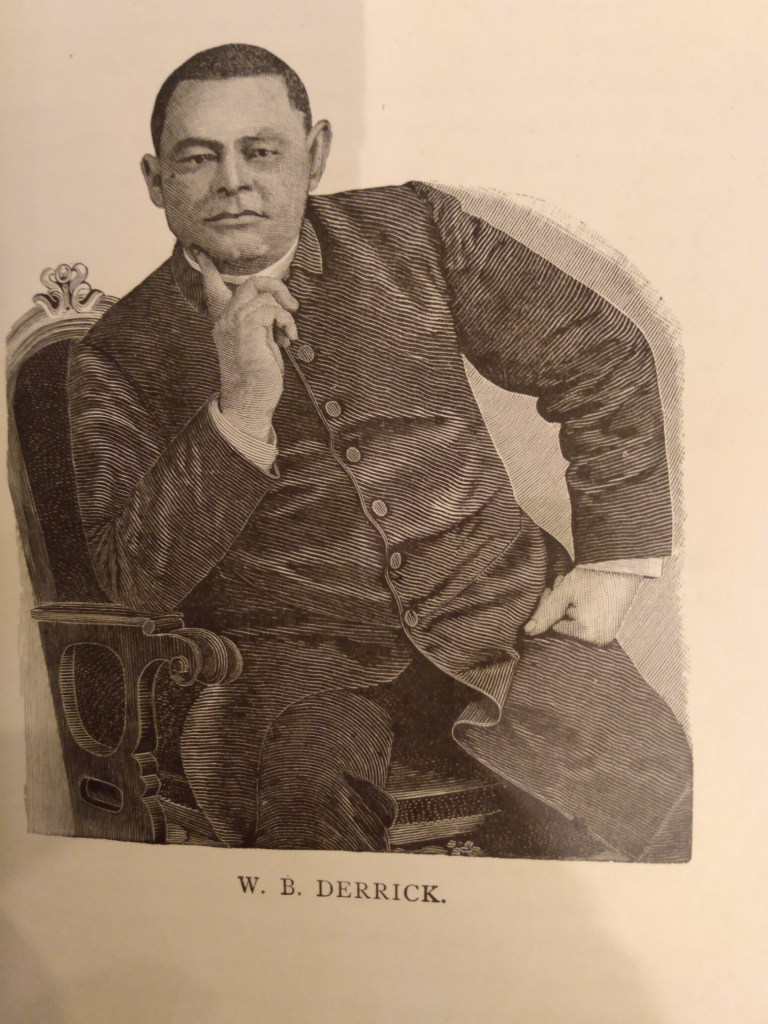
2. REV. W. B. DERRICK, D. D.
Minister of the African M. E. Church – Pulpit Orator.
The subject of this sketch was born on the Island of Antigua, in the British West Indies, July 27, 1843. Nineteen years after the boon of emancipation was conferred on those islands by the British Parliament, in 1834, Antigua, his native land, was the first island in the British West Indies which had the courage to ameliorate her slave laws, by affording the accused the benefit of a trial by jury; and an act of the assembly, February 13, 1834, decreed the emancipation of every slave without requiring a period of apprenticeship prescribed by the British Parliament. She refused to believe in the virtues of apprenticeship to prepare her bondsmen for freedom; if they were to be liberated, why not at once? And she has never had occasion to repent it.
His father, Thomas J. Derrick, belonged to the highly respectable family of Derricks who were large planters in the islands of Antigua and Anguila. His mother, Eliza, was of medium height, with regular features always lighted up with smiles, of genial disposition, and a mind well stored with witty and original thoughts, which rendered her conversation interesting, animating and devoid of monotony. Both parents are now slumbering, the former in the cemetery of the village church, the latter beneath the pendant branches of the mahogany tree in the public cemetery of the metropolis of the island. Mr. Derrick when very young was sent to a private school, and at the end of two years was admitted in the public school at Gracefield, under the auspices of the Moravians, and regularly attended from 1848 until the spring of 1856, when the head master of said school was removed to another charge. During these eight years, his progress at every stage in his studies was rapid and substantial, as if he had adopted for his motto “I will excel.” His natural talent, especially for oratory, elicited general applause at the annual examinations, largely attended by the elite of the neighborhood, who took special interest in the cause of education. In his class, conspicuous for his uncommonly large head, high forehead and penetrating eyes, he stood among the few who could manfully grapple with the difficult questions put by the tutor. In the spring of 1856, he was sent to a select private high school in the metropolis, under the tutorship of J. Wilson, Esquire, a fine classical scholar, but a great disciplinarian. Here he remained three years. He was afterward sent to learn the trade of a blacksmith. His parents finally consented to let him go to sea, under the care of Captain Crane, with the understanding that he was to be taught the science of navigation, and at the end of two or three years to return home and embark in business. On the sixth of May, 1860, he was on his first voyage to the United States. The ship was soon enveloped in a violent storm, and driven ashore at Turk’s Island, but saved from becoming a total wreck. She took in her cargo, however, and sailed to New York. After a voyage of fourteen days, the merchantman reached the back – waters and continued to glide until she reached Sandy Hook. On coming along the Jersey coast, some altercations on the term “nigger” being applied to him, took place between an Irishman and himself, which ended in his convincing the young Irishman, pugilistically, that his complexion had nothing to do with his manhood. He did considerable sailing around in ships, visiting the coast of Massachusetts and other places, and finally came to Boston. On this trip he met with a serious accident, namely, the breaking of his leg in two places. The case was aggravated by not having a surgeon on the spot for treatment. After making several trips and being shipwrecked, he volunteered in the service of the United States government for three years, and was assigned to the flagship Minnesota, of the North Atlantic squadron. He was thrown among five hundred other sailors, of all nationalities, who, like himself, were enlisted on the side of right. War absorbed his whole soul, yet with all this he could not repress the old idea, or smother the returning voice of the spirit which seemed to haunt him, urging him to enter the Christian ministry. When he met with the accident previously alluded to, he had had serious thoughts concerning this matter. Like a nail driven in a sure place by “the master of assemblies,” there was no getting away from him who was determined to be heard amid the din and roar of artillery and the shrieks of shells. The hand of the Lord was upon him. He was formally enrolled in the list of sailors from 1861 to 1864 and contributed his quota to the gallant exploits land glorious achievements, and shared in the trials and triumphs of those brave ones in their struggles and conquests in the civil war.
Many incidents transpired while he remained on board his floating home, many of which beggar description, as, in the conflict between the Merrimac and Monitor, and in the heartrending scenes of carnage and blood. He was an American citizen now, and having been dismissed from the United States navy, took two steps, one in leading the altar of matrimony Miss Mary E. White, the only daughter of Edwin White, Esq., of Norfolk, Virginia, and the other to take the initiatory to enter the ministry of the African M.E. Church by joining the church at Washington, District of Columbia, under the pastoral care of Rev., [now] Bishop J.M. Brown, who, after the usual preliminaries, licensed him to preach and at the same time to act as missionary agent, both of which offices he held until 1867. He was then admitted to the regular traveling connection, appointed by the Rt. Rev. D. A. Payne, D. D., LL. D., to Mt. Pisgah chapel, Washington, District of Columbia, where he labored for one year as preacher and teacher. In the year 1868 he was ordained deacon, and transferred to the Virginia conference, which closed before he arrived. His only alternative was to accept one of the most impoverished missions in the district, situated in the Alleghany mountains, almost on the border of the Tennessee line. At the annual conference at Portsmouth, he was elected elder and was ordained by Bishop J. P. Campbell, D. D., LL. D., after which he was appointed pastor and presiding elder of the Staunton church and district. From this time he may be said to be firmly established in the Christian ministry. He was reappointed presiding elder, pastor and conference secretary at the annual conference held in Norfolk in 1870; Staunton, 1871; Richmond, 1872; Portsmouth, 1873; Danville, 1874; Richmond, 1875; Portsmouth, 1876; Wytheville, 1877; Farmville, 1878; and Hampton, 1879; as a delegate to the general conference held in Nashville, 1872, at Atlanta, Georgia, 1876, and at Baltimore, Maryland, 1884, serving on all important committees in the sessions. In politics he has taken an active part. In Virginia, when the question of readjusting the State was agitating the country, and was submitted to the people to be voted upon in the November elections of 1879, he took sides with the party that was in favor of paying the debt as had been contracted. This party was known as the “Funders.” His attitude was in perfect harmony with the platform of the National Republican party insomuch that the administration at Washington sanctioned his course again. As the colored people were considered dangerous and willing tools in the hands of ambitious men, who were unscrupulous and always ready to make use of them in furthering their own ends, regardless of consequences, he publicly denounced the faction known as “Readjusters,” who repudiated the payment of an honest debt. This controversy was considered the most vindictive political war ever waged in that section, and lasted several months, terminating in the triumph of the “Readjusters.” Mr. Derrick was disgusted, and knowing full well that as leader of the opposite faction he would have to suffer, he resigned his charge, left the South again, and took a trip to the West Indies in company with his wife. In this tour he traveled in the Bermudas, Jamaica, St. Thomas and Antigua, his native land. After twenty years absence he first visited the home of his oldest sister; then the graves of his departed parents and other members of the family. He preached and lectured to almost all the churches, on popular subjects. Returning to the United States, he resumed his ministerial duties. He has since served churches in Salem, New Jersey; Albany, New York, and Sullivan Street church, New York City, where he continues to enjoy the confidence of the members of his church and the community at large.
The doctor has many personal admirers and they will read with interest a book of over three hundred pages, in press at this writing, which will contain a “Tribute to the Life and Labors of Rev. W. B. Derrick, D. D., Minister of the A.M.E. Church.” The contents will be about as follows:
Preface; Dedication to the Sons and Daughters of Liberty in the United States and the West Indies; Recommendatory Letters from Bishop H. M. Turner, D. D., Rev. Dr. B. T. Tanner, Rev. J. A. Handy, D. D., Professor T. McCants Stewart, LL. B., Rev. W. H. Thomas, A.M., Rev. T. T. B. Reid, B. A.; Outline History of Antigua, Dr. Derrick’s native land; Notices of some of the leading men in the A. M. E. Church – the whole work of his life covering four periods, viz:
PERIOD I. – His Childhood and Youth.
PERIOD II. – Life Abroad; or, The Young Man from Home.
PERIOD III. – In the American Navy during the Civil War.
PERIOD IV. – Twenty – three years in the Ministry of the A. M. E. Church; Sermons and Orations and Contributions to the Press.
His sermons, addresses and speeches are noticed in the New York Tribune, Sun, Herald, Times, the Evening Telegram, the Christian Recorder and the leading colored journals in this country, such as the New York Freeman and the Boston Advocate. He is a staunch Republican in politics, a progressive and evangelical preacher of the gospel, filled with the broad benevolence of Heaven and unwearied in his efforts to save immortal souls. The Wilberforce University conferred upon him the title of D. D., in 1885. He is an honorary member of the I. O. G. Templars, the Masonic Body, Odd-Fellows and Good Samaritans, the Publication Board of the A. M. E. Church and trustee of Wilberforce University. He has succeeded in accumulating about five thousand dollars worth of property, and was also the executor of the late lamented Bishop R. H. Cain, D. D., who died at his residence in New York City. He has paid an elaborate tribute to the virtues of the deceased in that city recently. He has been offered the superintendency of the church work in the West Indies, but respectfully declined. He is a diligent student of the Bible and as a pastor is ever solicitous that his flock should be fed with the “bread of life.” His church is justly proud of his works, which show wisdom and care on his part. No man has a higher standing in this country, for his power is felt among all classes. His rich voice and personal magnetism make him powerful in the field of oratory. His qualities of head and heart, his sound patriotism and sturdy manhood mark him a progressive man of the age.
The Evening Telegram, New York, gave “Sketches of Some of the Prominent Divines,” had the following, among other good things, to say of Rev. Dr. Derrick:
After leaving Albany, Dr. Derrick became pastor of the Sullivan Street Church, which is situated in the heart of the largest colored colony in this metropolis. His church is a low browed and plain brick structure, but it is roomy inside, and is generally well filled with a class of worshipers much more devout than are to be found in many churches frequented by white persons. Dr. Derrick is a short, stout, full and smooth – faced man of light color, with great command of language and exceeding felicity of illustration to suit the plain understanding and comprehension of the people with whom he labors. Outside of the pulpit, he exercises a shrewd business supervision of the personal affairs of his flock, and serves them as legal adviser and political leader. He is an ardent Republican.
As presiding elder, his district embraces Fleet Street Church, Brooklyn, and the African Methodist Episcopal churches at Williamsburg, Flushing, Melrose, Albany, Chatham, Kinderhook, Catskill, Coxsackle, White Plains and Harlem Mission. The church which Dr. Derrick has charge of is valued at $80,000, and the adjoining parsonage is worth $10,000 more. He is paid $2,000 per annum, a furnished house included. They also support a paid choir under Professor Savage, one of the best musicians of the race. The church membership is 1,000, and the seating capacity of the building 1,500, but frequently more than 2,000 worshipers stand within its walls and listen to the eloquent appeals of its pastor in behalf of human progress.
In June, 1884, he was nominated as a Presidential elector – at – large by the Republican State Committee, at the instance of Fire Commissioner Van Cott. There was considerable opposition among his own race to the nomination. It was headed by John J. Freeman, the then editor of the Progressive American. The opposition alleged that Dr. Derrick was not a citizen, and, therefore, could not serve as an elector. W. H. Johnson, ex-janitor of the State Senate, made affidavit that once after a ward meeting, in Albany, which Dr. Derrick had attended, he asked why Dr. Derrick did not vote, and that Dr. Derrick said he was not a citizen, having been born in the West Indies, and never having taken out naturalization papers. When asked why he had not been naturalized, he replied that he did not wish to give up his allegiance to Her Gracious Majesty, the Queen, as he had intended to stay in this country only until he had amassed sufficient means to live like a gentleman at home, where living was cheap.
A CITIZEN.
On July 1, Dr. Derrick declined the nomination. He took this action, however, before he knew of the Albany affidavits, his reason being that he had been chosen by his church to assist in arranging for the centennial celebration of American Methodism, and, therefore, had not time to be an elector. This was the first time his citizenship was called in question, although he had exercised his rights and privileges as a citizen. He proved at the time that he had come to this country when he was seventeen years old, and that when he enlisted in the navy he had taken the oath of allegiance to the United States.
 busyorganizing