
Tag Archives: christianity

MEN OF MARK

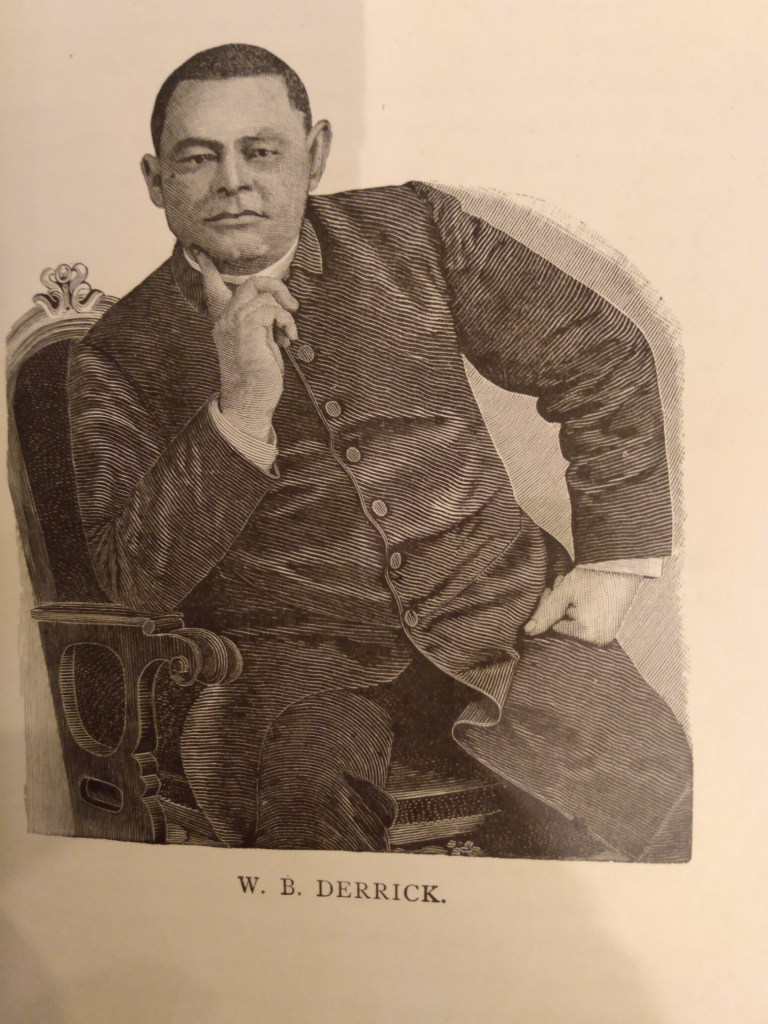
2. REV. W. B. DERRICK, D. D.

Minister of the African M. E. Church – Pulpit Orator.

The subject of this sketch was born on the Island of Antigua, in the British West Indies, July 27, 1843. Nineteen years after the boon of emancipation was conferred on those islands by the British Parliament, in 1834, Antigua, his native land, was the first island in the British West Indies which had the courage to ameliorate her slave laws, by affording the accused the benefit of a trial by jury; and an act of the assembly, February 13, 1834, decreed the emancipation of every slave without requiring a period of apprenticeship prescribed by the British Parliament. She refused to believe in the virtues of apprenticeship to prepare her bondsmen for freedom; if they were to be liberated, why not at once? And she has never had occasion to repent it.

His father, Thomas J. Derrick, belonged to the highly respectable family of Derricks who were large planters in the islands of Antigua and Anguila. His mother, Eliza, was of medium height, with regular features always lighted up with smiles, of genial disposition, and a mind well stored with witty and original thoughts, which rendered her conversation interesting, animating and devoid of monotony. Both parents are now slumbering, the former in the cemetery of the village church, the latter beneath the pendant branches of the mahogany tree in the public cemetery of the metropolis of the island. Mr. Derrick when very young was sent to a private school, and at the end of two years was admitted in the public school at Gracefield, under the auspices of the Moravians, and regularly attended from 1848 until the spring of 1856, when the head master of said school was removed to another charge. During these eight years, his progress at every stage in his studies was rapid and substantial, as if he had adopted for his motto “I will excel.” His natural talent, especially for oratory, elicited general applause at the annual examinations, largely attended by the elite of the neighborhood, who took special interest in the cause of education. In his class, conspicuous for his uncommonly large head, high forehead and penetrating eyes, he stood among the few who could manfully grapple with the difficult questions put by the tutor. In the spring of 1856, he was sent to a select private high school in the metropolis, under the tutorship of J. Wilson, Esquire, a fine classical scholar, but a great disciplinarian. Here he remained three years. He was afterward sent to learn the trade of a blacksmith. His parents finally consented to let him go to sea, under the care of Captain Crane, with the understanding that he was to be taught the science of navigation, and at the end of two or three years to return home and embark in business. On the sixth of May, 1860, he was on his first voyage to the United States. The ship was soon enveloped in a violent storm, and driven ashore at Turk’s Island, but saved from becoming a total wreck. She took in her cargo, however, and sailed to New York. After a voyage of fourteen days, the merchantman reached the back – waters and continued to glide until she reached Sandy Hook. On coming along the Jersey coast, some altercations on the term “nigger” being applied to him, took place between an Irishman and himself, which ended in his convincing the young Irishman, pugilistically, that his complexion had nothing to do with his manhood. He did considerable sailing around in ships, visiting the coast of Massachusetts and other places, and finally came to Boston. On this trip he met with a serious accident, namely, the breaking of his leg in two places. The case was aggravated by not having a surgeon on the spot for treatment. After making several trips and being shipwrecked, he volunteered in the service of the United States government for three years, and was assigned to the flagship Minnesota, of the North Atlantic squadron. He was thrown among five hundred other sailors, of all nationalities, who, like himself, were enlisted on the side of right. War absorbed his whole soul, yet with all this he could not repress the old idea, or smother the returning voice of the spirit which seemed to haunt him, urging him to enter the Christian ministry. When he met with the accident previously alluded to, he had had serious thoughts concerning this matter. Like a nail driven in a sure place by “the master of assemblies,” there was no getting away from him who was determined to be heard amid the din and roar of artillery and the shrieks of shells. The hand of the Lord was upon him. He was formally enrolled in the list of sailors from 1861 to 1864 and contributed his quota to the gallant exploits land glorious achievements, and shared in the trials and triumphs of those brave ones in their struggles and conquests in the civil war.

Many incidents transpired while he remained on board his floating home, many of which beggar description, as, in the conflict between the Merrimac and Monitor, and in the heartrending scenes of carnage and blood. He was an American citizen now, and having been dismissed from the United States navy, took two steps, one in leading the altar of matrimony Miss Mary E. White, the only daughter of Edwin White, Esq., of Norfolk, Virginia, and the other to take the initiatory to enter the ministry of the African M.E. Church by joining the church at Washington, District of Columbia, under the pastoral care of Rev., [now] Bishop J.M. Brown, who, after the usual preliminaries, licensed him to preach and at the same time to act as missionary agent, both of which offices he held until 1867. He was then admitted to the regular traveling connection, appointed by the Rt. Rev. D. A. Payne, D. D., LL. D., to Mt. Pisgah chapel, Washington, District of Columbia, where he labored for one year as preacher and teacher. In the year 1868 he was ordained deacon, and transferred to the Virginia conference, which closed before he arrived. His only alternative was to accept one of the most impoverished missions in the district, situated in the Alleghany mountains, almost on the border of the Tennessee line. At the annual conference at Portsmouth, he was elected elder and was ordained by Bishop J. P. Campbell, D. D., LL. D., after which he was appointed pastor and presiding elder of the Staunton church and district. From this time he may be said to be firmly established in the Christian ministry. He was reappointed presiding elder, pastor and conference secretary at the annual conference held in Norfolk in 1870; Staunton, 1871; Richmond, 1872; Portsmouth, 1873; Danville, 1874; Richmond, 1875; Portsmouth, 1876; Wytheville, 1877; Farmville, 1878; and Hampton, 1879; as a delegate to the general conference held in Nashville, 1872, at Atlanta, Georgia, 1876, and at Baltimore, Maryland, 1884, serving on all important committees in the sessions. In politics he has taken an active part. In Virginia, when the question of readjusting the State was agitating the country, and was submitted to the people to be voted upon in the November elections of 1879, he took sides with the party that was in favor of paying the debt as had been contracted. This party was known as the “Funders.” His attitude was in perfect harmony with the platform of the National Republican party insomuch that the administration at Washington sanctioned his course again. As the colored people were considered dangerous and willing tools in the hands of ambitious men, who were unscrupulous and always ready to make use of them in furthering their own ends, regardless of consequences, he publicly denounced the faction known as “Readjusters,” who repudiated the payment of an honest debt. This controversy was considered the most vindictive political war ever waged in that section, and lasted several months, terminating in the triumph of the “Readjusters.” Mr. Derrick was disgusted, and knowing full well that as leader of the opposite faction he would have to suffer, he resigned his charge, left the South again, and took a trip to the West Indies in company with his wife. In this tour he traveled in the Bermudas, Jamaica, St. Thomas and Antigua, his native land. After twenty years absence he first visited the home of his oldest sister; then the graves of his departed parents and other members of the family. He preached and lectured to almost all the churches, on popular subjects. Returning to the United States, he resumed his ministerial duties. He has since served churches in Salem, New Jersey; Albany, New York, and Sullivan Street church, New York City, where he continues to enjoy the confidence of the members of his church and the community at large.

The doctor has many personal admirers and they will read with interest a book of over three hundred pages, in press at this writing, which will contain a “Tribute to the Life and Labors of Rev. W. B. Derrick, D. D., Minister of the A.M.E. Church.” The contents will be about as follows:

Preface; Dedication to the Sons and Daughters of Liberty in the United States and the West Indies; Recommendatory Letters from Bishop H. M. Turner, D. D., Rev. Dr. B. T. Tanner, Rev. J. A. Handy, D. D., Professor T. McCants Stewart, LL. B., Rev. W. H. Thomas, A.M., Rev. T. T. B. Reid, B. A.; Outline History of Antigua, Dr. Derrick’s native land; Notices of some of the leading men in the A. M. E. Church – the whole work of his life covering four periods, viz:

PERIOD I. – His Childhood and Youth.

PERIOD II. – Life Abroad; or, The Young Man from Home.

PERIOD III. – In the American Navy during the Civil War.

PERIOD IV. – Twenty – three years in the Ministry of the A. M. E. Church; Sermons and Orations and Contributions to the Press.

His sermons, addresses and speeches are noticed in the New York Tribune, Sun, Herald, Times, the Evening Telegram, the Christian Recorder and the leading colored journals in this country, such as the New York Freeman and the Boston Advocate. He is a staunch Republican in politics, a progressive and evangelical preacher of the gospel, filled with the broad benevolence of Heaven and unwearied in his efforts to save immortal souls. The Wilberforce University conferred upon him the title of D. D., in 1885. He is an honorary member of the I. O. G. Templars, the Masonic Body, Odd-Fellows and Good Samaritans, the Publication Board of the A. M. E. Church and trustee of Wilberforce University. He has succeeded in accumulating about five thousand dollars worth of property, and was also the executor of the late lamented Bishop R. H. Cain, D. D., who died at his residence in New York City. He has paid an elaborate tribute to the virtues of the deceased in that city recently. He has been offered the superintendency of the church work in the West Indies, but respectfully declined. He is a diligent student of the Bible and as a pastor is ever solicitous that his flock should be fed with the “bread of life.” His church is justly proud of his works, which show wisdom and care on his part. No man has a higher standing in this country, for his power is felt among all classes. His rich voice and personal magnetism make him powerful in the field of oratory. His qualities of head and heart, his sound patriotism and sturdy manhood mark him a progressive man of the age.

The Evening Telegram, New York, gave “Sketches of Some of the Prominent Divines,” had the following, among other good things, to say of Rev. Dr. Derrick:

After leaving Albany, Dr. Derrick became pastor of the Sullivan Street Church, which is situated in the heart of the largest colored colony in this metropolis. His church is a low browed and plain brick structure, but it is roomy inside, and is generally well filled with a class of worshipers much more devout than are to be found in many churches frequented by white persons. Dr. Derrick is a short, stout, full and smooth – faced man of light color, with great command of language and exceeding felicity of illustration to suit the plain understanding and comprehension of the people with whom he labors. Outside of the pulpit, he exercises a shrewd business supervision of the personal affairs of his flock, and serves them as legal adviser and political leader. He is an ardent Republican.

As presiding elder, his district embraces Fleet Street Church, Brooklyn, and the African Methodist Episcopal churches at Williamsburg, Flushing, Melrose, Albany, Chatham, Kinderhook, Catskill, Coxsackle, White Plains and Harlem Mission. The church which Dr. Derrick has charge of is valued at $80,000, and the adjoining parsonage is worth $10,000 more. He is paid $2,000 per annum, a furnished house included. They also support a paid choir under Professor Savage, one of the best musicians of the race. The church membership is 1,000, and the seating capacity of the building 1,500, but frequently more than 2,000 worshipers stand within its walls and listen to the eloquent appeals of its pastor in behalf of human progress.

In June, 1884, he was nominated as a Presidential elector – at – large by the Republican State Committee, at the instance of Fire Commissioner Van Cott. There was considerable opposition among his own race to the nomination. It was headed by John J. Freeman, the then editor of the Progressive American. The opposition alleged that Dr. Derrick was not a citizen, and, therefore, could not serve as an elector. W. H. Johnson, ex-janitor of the State Senate, made affidavit that once after a ward meeting, in Albany, which Dr. Derrick had attended, he asked why Dr. Derrick did not vote, and that Dr. Derrick said he was not a citizen, having been born in the West Indies, and never having taken out naturalization papers. When asked why he had not been naturalized, he replied that he did not wish to give up his allegiance to Her Gracious Majesty, the Queen, as he had intended to stay in this country only until he had amassed sufficient means to live like a gentleman at home, where living was cheap.

A CITIZEN.

On July 1, Dr. Derrick declined the nomination. He took this action, however, before he knew of the Albany affidavits, his reason being that he had been chosen by his church to assist in arranging for the centennial celebration of American Methodism, and, therefore, had not time to be an elector. This was the first time his citizenship was called in question, although he had exercised his rights and privileges as a citizen. He proved at the time that he had come to this country when he was seventeen years old, and that when he enlisted in the navy he had taken the oath of allegiance to the United States.
MEN OF MARK

INTRODUCTION CONTINUED – 5

(CONTINUED FROM 7/17/24)

The great National Convention of colored men held at Louisville, September, 1883, enrolled him as a member. His love for the people is shown in the following little incident. While serving as a member of the committee on education and labor, a proposition was made to ask Congress to pass a bill giving the monies which had been left in the treasury from the unclaimed bounties of colored soldiers to the high schools of the South, which would of course have included the denominational, and excluded the public schools. Against this he protested, notwithstanding he was at the head of the denominational school which would have received benefits, on the grounds that the masses should be aided and not the few, and because it was a lack of statesmanship and knowledge of the laws governing the land to ask aid for denominational schools. The committee voted him down solidly, but when the matter was called up in the convention, he took the platform and made a speech so convincing that the chairman, Hon. D. A. Straker, LL. D., of South Carolina, was called upon to change the report, which was done with good grace. At the convention of the Knights of Wise Men, held in Atlanta, Georgia, he took an active part in the deliberations. He has delivered several addresses before the American Baptist Home Mission Society. At the fiftieth anniversary held in New York, May 24, 1872, his orientation, “What are the Colored People Doing?” was much spoken of and published in the Jubilee Volume. He delivered another before the same body, May 26-27, 1885, at Saratoga, and has been invited to address the next meeting, May 29, 1887, at Minneapolis. In 1884, he was appointed by Hon. B. K. Bruce commissioner for the State of Kentucky in the colored department of the World’s Industrial and Cotton Exposition held at New Orleans, Louisiana, and succeeded in giving a splendid representation, thereby reflecting credit on the State. The school over which he presided made a creditable exhibit. The trustee board, in making the annual report to the General Association of Colored Baptists, said:

At the suggestion of our worthy president, who was also the commissioner for Kentucky for the World’s Exposition at New Orleans, an exhibition of our University, of both the literary and industrial work, was sent to the Exposition. To say that the display was complete and satisfactory is but to state it mildly. It has done much to advertise our University, and shows the capacity of our people for both education and industrial pursuits.

In September, 1883, Dr. Simmons called together and organized the Baptist women into a convention, for the purpose of raising money for the educational work of the denomination in the State. The body known as the “Baptist Women’s Educational Convention” has met every year since, and has and is doing a noble work in paying off the indebtedness of the State University.

Were you to ask me Dr. Simmons’ motto, I would say, “God, my race and denomination.” While holding tenaciously his own religious views, he is willing for other men to hold theirs. Among his strongest friends are eminent preachers, scholars and laymen of every denomination in the United States with which colored people are allied. The fact that the Wilberforce University conferred upon him the degree of D. D. is ample evidence of the friendliness existing between him and the brethren of that faith. The faculty of said school ranks with the most eminent men of America, among whom are Reverend B. W. Arnett, D. D., Professor W. S. Scarborough, LL.D., Bishops D. A. Payne, D. D., LL.D., John M. Brown, D.D., D.C.L., and others of like grace and eminence.

Being impressed with the idea that colored Baptists were not doing what they should for the support and influence of their peculiar views, he suggested, through the American Baptist, April 5, 1886, that a convention be held. This suggestion was heartily endorsed by Baptists throughout the United States. He issued the call at their suggestion, and the result was organization of the American National Baptist Convention, which met, August 25, 1886, in St. Louis, Mo., and of which he was unanimously elected president, and chairman of the executive committee. He preached the denominational sermon which was published in the minutes. It was rich in statistics and history, pregnant with the faith as handed down from the Apostles. He concluded by saying:

The work of the colored Baptists is marvelous, aye, stupendous. When we remember our elevation to-day, it is not with undue pride; no! no! no! with thanksgiving and humiliation, with self-abasement and lowliness, and with an earnest prayer for more faith, we lift our eyes to the Great Father of souls and pray His righteous benediction, that we bow our heads because we have been unprofitable servants. Yet it is with astonishment that we have reached such lofty heights, and with remarkable pleasure do we look back upon the depths from which we came. Driven out, Hagar-like, we have, Ishmael-like, still become a people and dwell in the presence of our brethren, and to-day, in figures bright and glowing in the ending of the nineteenth century, we count fully 1,071,000 – every sign of progress. It might be remarked, if we can rise to this point with few learned men, what shall be the result in the next twenty years? Books, papers, magazines and pamphlets shall be as plentiful as the maple leaves in full blown spring.

The Baptist host is like a cube; throw them aside and they always land on an equal side, and you need never despair when in your trials and doubts in your several churches; remember the God of battles is on your side and that the ages have only increased His glory.

His knowledge of the tenets of the denomination with which he is identified is marvelous. In this direction his research has been thorough and extensive as is shown in an article on “Baptism” published in the A. M. E. Review, October, 1886, in reply to Rev. B. W. Williams.

As an orator Dr. Simmons is pleasing to his audience. A quick thinker, and possessing a rich and ready flow of choice language, a figure that can be seen, and a voice that can be heard at a distance. At times, in the heat of debate, the whole grandeur of his soul is transfused into his countenance; and his hearers are electrified as only true eloquence can electrify.

He was invited to address the students of three different colleges in one year. At Selma University, May 28, 1885, his subject was “True Manliness.” The Baptist Pioneer commented as follows:

For nearly an hour and a half the speaker held the large audience spellbound. He was eloquent and inspiring. Rarely have we listened to a more practical oration. At times the audience was convulsed with laughter at the wit, and then immediately made to reflect under the solid words of wisdom which fell from the speaker’s lips.

His address before the Berea College students, subject “The Great Text-Book of the Ages,” received much comment. June 18, 1885, after delivering an oration before the Wilberforce Literary Society, subject “Leaders and Followers,” he had conferred on him the degree of D.D., by that venerable institution. In 1881, he had received the degree of A. M., from Howard University. During the educational movement in Kentucky, in 1885, I think, Dr. Simmons delivered a speech before the Inter-State Educational Convention, which was held in the white Baptist church, subject “The Education of the Negro Race.” In this convention were found the most eminent educators, State superintendents and the most noted thinkers in America. Favorable criticism was made by the New York Journal of Education, the Courier-Journal of Louisville, and other State papers.

He delivered an oration at the Lexington Emancipation celebration, January 1, 1887. Urging the hearers to greater efforts, he said:

The warm blood of the Negro that haunts the channels of his veins with ancient Egyptian and Ethiopian fires has been tempered in the climate of the South and reduced to that proportion which robs it of its sluggishness, subdues it of wild passion and holds it by reason, while the trials of the past have been the friction that brightens, the winds that toughen, and the frosts that ripen. No great song, or poem, or book, or invention has yet seen birth south of the “Mason and Dixon Line.” It has been reserved for us. The only American music was born on the plantations and wrung from aching hearts as wine from the luscious grape. It has touched the heart of the learned and engaged the attention of the scientific musician. As the Indian faded in the North, before the white man, so the white man of the South must yield to us, without, however, a bloody conflict. We shall gather wealth, learning and manhood and occupy the land. This is the asylum of the world; and the tramp of hurrying nations warns us that this is the “Valley of Decision.” On this soil are settled the great questions of the earth. Already the march of empire has bathed its weary feet in the Pacific, and with the exception of watery waste has arrived at its home, and it is possible that He who made all nations of one blood, will here in our land, marry and intermarry, and reduce this conglomerate mass to one distinct nationality, with all the blood made one, and the highest type of consecrated manhood being realized, reduced back to the Adamic color through us; or He may out of the aggregate develop each to its highest type, and let them live to the end of time, carrying out His divine plans, and unerringly accomplishing His decrees. Here in this new South the Negro shall shine in the constellation of the nations, and by his words and deeds hand down to unborn ages the glittering pages of our history. We shall in some prominent way mount the ladder of difficulties, scale the cliff of prejudices and hide our heads among the stars.

TO BE CONTINUED…

MEN OF MARK

INTRODUCTION CONTINUED – 2

(CONTINUED FROM 7/10/24)

His army life was not uneventful; he took part in battles around Petersburg, Hatches Run, Appomattox Court House, and was present at the surrender of Lee, the crises out of which our own happier cycle of years has been evolved. He was discharged September 13, 1865, and in 1866 and 1867 worked as journeyman at his trade for Dr. William H. Longfellow, a colored dentist of Philadelphia, after which he returned to Dr. DeLange.

He was converted in 1867 and joined the white Baptist church in Bordentown, pastored by Rev. J. W. Custis, a brilliant man, under whose influence about one hundred and fifty had joined the church that spring.

Although the only colored man in the church, he was treated with much kindness; and when his call to the Gospel ministry was made known, they rallied to his support, defraying his school expenses three years. The New Jersey State Educational Society aided him to attend Madison University of New York, from which he graduated in 1868, taking the academic course. Both students and teachers were his warm friends and are today. The dark skinned youth, though alone, never felt the sting of injustice at their hands. September, 1868, found him matriculated at Rochester University, having been led to make the change by an offer of additional aid by laboring in a small Baptist church in Rochester, and because there he found colored people among whom he could associate and do missionary work. At this early date we see cropping out the love for the race which in after years became one of the ruling passions of his life.

One pleasant year slipped by, and the freshman year completed, when his eyes became seriously affected. The trouble was brought on by continuous night study of Greek during his academic year. This prevented school attendance until the year 1871 when he entered Howard University, Washington, District of Columbia, and graduated as an A. B. in 1873. His graduating oration treating of the Darwinian theory, a subject then very popular in literary circles, attracted much attention and newspaper comments. Extracts were printed in a paper in England devoted to science and literature.

At many periods, his school life was a sequel to the days of deprivation of childhood. Time and again he would be forced to stay indoors while having his only shirt laundried. Poor shoes and patched clothes were the rule, not the exception. During his entire course he did not have a whole suit until reaching the senior year. Once he ate cheese and crackers three weeks. During the senior year, September, 1872, to June, 1873, he walked seven miles a day, and taught school; came home and drilled the cadet company from four to five; recited at night, and graduated with the salutatory of the class. That was a happy day; by frugality he had saved three hundred dollars. Commencement day for him ended many deprivations and sacrifices in one sense. Both have come since, but of a different character and easier to bear. In the world one can find means of replenishing his purse, and many opportunities of changing his circumstances; but with a student it is different. He must in a degree be stationary, and cannot move around for the purpose of getting benefits.

During these years his mother lavished on him the devotion and pride of a loving heart. She washed, ironed and labored in other ways to help him. In this she was greatly assisted by one Bunting Hankins and his devoted wife of Bordentown, New Jersey, in whose family she labored. General O. O. Howard, president of Howard University, and General E. Whittlesey, dean of the college department, showed him many kindnesses during and after college days. While a student, he showed such aptness to teach in conducting a school at a place called Bunker’s Hill, rebuilding it almost from nothing, that the school-board promoted him to the principalship of a much larger building, with several hundred scholars. This was the Hillsdale Public school, District of Columbia. Here he boarded in the house of Hon. Solomon G. Brown, one of the ablest scientists in this country.

Immediately after graduating, he took Horace Greeley’s advice, and went west, to Arkansas, with the idea of making it his home; was examined and secured a State certificate from the Honorable Superintendent of Education, J. C. Corbin, but soon returned to Washington and taught at Hillsdale until June, 1874.

After marrying Josephine A., the daughter of John and Caroline Silence, in Washington, District of Columbia, August 25, 1874, he went south. By this union they have had the following children: Josephine Lavinia, William Johnson, Maud Marie, Amanda Moss, Mary Beatrice, John Thomas and Gussie Lewis. Desiring to better his financial condition he went to Florida, September, 1874, and invested in lands and oranges, but the investment did not prove a paying one. While in Ocala (in 1879) he was ordained a deacon, and was licensed to preach without asking for it. Pastored at a small station a year before ordination, after which time, he was ordained the night before leaving the State.

He was principal of Howard Academy, deputy county clerk and county commissioner. Here, too, his political tendencies received an impetus. He was chairman of the county campaign committee, and a member of the district congressional committee. Stumped the county for Hayes and Wheeler, and when it is remembered that the state went only 147 majority for Hayes, it is quite a material thing that the county in which he lived raised its quota from 525 Republican majority to 986. After this he returned to Washington and taught public school until 1879, when he left to accept the pastorate of the First Baptist church, Lexington, Kentucky. To do great work, God raises up great men.

September, 1880, he was called to the presidency of the Normal and Theological institution (as it was then called), a school conducted under the auspices of the General Association of Colored Baptists of Kentucky. At that time the school had but thirteen pupils, two teachers and an empty treasury. Says the Bowling Green Watchmen, a State paper edited by Rev. Eugene Evans:

Few men of Professor Simmons’ ability and standing would have been willing to risk their future in an enterprise like the Normal and Theological Institution; an enterprise without capital and but a few friends. But it can be truly said of Professor Simmons, that he has proven himself master of the situation. The school had been talked of for nearly twenty years’ but no one ever dreamed of its being a possibility. When he was elected president, every cloud vanished, and the sunshine of success could be seen on every side. Some of his students already rank among the foremost preachers, teachers and orators of the State.

To Be Continued.

MEN of MARK

My husband inherited this book from his grandfather, who was born in 1885. When I first laid eyes on it, I wept. This precious book, gift, gives insight into the lives of Black people in early, America.

PREFACE.

To PRESUME to multiply books in this day of excellent writers and learned book-makers is a rash thing perhaps for a novice. It may even be a presumption that shall be met by the production itself being driven from the market by the keen, searching criticism of not only the reviewers, but less noted objectors. And yet there are books that meet a ready sale because they seem like “Ishmaelites” – against everybody and everybody against them. Whether this work shall ever accomplish the design of the author may not at all be determined by its sale. While I hope to secure some pecuniary gain that I may accompany it with a companion illustrating what our women have done, yet by no means do I send it forth with the sordid idea of gain. I would rather it would do some good than make a single dollar, and I echo the wish of “Abou Ben Adhem,” in that sweet poem of that name, written by Leigh Hunt. The angel was writing at the table, in his vision, (The names of those who love the Lord.) Abou wanted to know if his was there – and the angel said “No.” Said Abou, (I pray thee, then, write me as one that loves his fellow-men.)

That is what I ask to be recorded of me.

(The angel wrote and vanished. The next night It came again, with a great awakening light, And showed the names whom love of God had blessed. And lo! Ben Adhem’s name led all the rest.

I desire that the book shall be a help to students, male and female, in the way of information concerning our great names.

I have noticed in my long experience as a teacher, that many of my students were wofully ignorant of the work of our great colored men – even ignorant of their names. If they knew their names, it was some indefinable something they had done – just what, they could not tell. If in a slight degree I shall here furnish the data for that class of rising men and women, I shall feel much pleased. Herein will be found many who had severe trials in making their way through schools of different grades. It is a suitable book, it is hoped, to be put into the hands of intelligent, aspiring young people everywhere, that they might see the means and manners of men’s elevation, and by this be led to undertake the task of going through high schools and colleges. If the persons herein mentioned could rise to the exalted stations which they have and do now hold, what is there to prevent any young man or woman from achieving greatness? Many, yea, nearly all these came from the loins of slave fathers, and were the babes of women in bondage, and themselves felt the leaden hand of slavery on their own bodies; but whether slaves or not, they suffered with their brethren because of color. That “sum of human villainies” did not crush out the life and manhood of the race. I wish the book to show to the world – to our oppressors and even our friends – that the Negro race is still alive, and must possess more intellectual vigor than any other section of the human family, or else how could they be crushed as slaves in all these years since 1620, and yet to-day stand side by side with the best blood in America, in white institutions, grappling with abstruse problems in Euclid and difficult classics, and master them? Was ever such a thing seen in another people? Whence these lawyers, doctors, authors, editors, divines, lecturers, linguists, scientists, college presidents and such, in one quarter of a century?

Another thing I would have them notice, that the spirituality of this race was not diminished in slavery. While in bondage, it may have been somewhat objectionable, as seen in the practices of our race, it must be remembered that they copied much from their owners, they never descended to the level of brutes, and were kind, loving and faithful. They patiently waited till God broke their chains. There was more statesmanship in the Negro slaves than in their masters. Thousands firmly believed they would live to be free, but their masters could not be persuaded to voluntarily accept pay from the government, and thus save the loss they afterwards bore through the “Emancipation.” They went to war and fought “the God of battles,” but the slaves waited, humbly feeding the wives and children of those who went to battle to rivet their chains. To my mind, one of the most sublime points in our history is right here. We never harmed one of these helpless women and children – they testified of that themselves. And yet they tell stale lies of ravishing now, when the war was over, and freedom gained, and when the men are all home. No, God has permitted us to triumph and through Him. He implanted in us a vigorous spiritual tree, and since freedom, how has this been growing? Untrammelled, we have, out of our ignorance and penury, built thousands of churches, started thousands of schools, educated millions of children, supported thousands of ministers of the Gospel, organized societies for the care of the sick and the burying of the dead. This spirituality and love of offspring are indubitable evidences that slavery, though long and protracted, met in our race a vigorous, vital, God-like spirituality, which like the palm tree flourishes and climbs upward through opposition.

Again, I admire these men. I have faith in my people. I wish to exalt them; I want their lives snatched from obscurity to become household matter for conversation. I have made copious extracts from their speeches, sermons, addresses, correspondence and other writings, for the purpose of showing their skill in handling the English language, and to show the range of the thoughts of the American Negro. I wish also to furnish specimens of Negro eloquence, that young men might find them handy for declamations and apt quotations. It was hard to draw the line in making many selections, and I do not claim that a better selection might not be made. Indeed, I am aware that many are entitled to a place here, and the reader may think I did wrong in selecting some of my subjects; but I ask no pardon for the names I present. They me be the judgment of a faulty brain, and yet there is much to admire in all. The extent of our country makes it impossible to secure all who may be “eminent, progressive and rising.” I trust I have presented a representative of many classes of those who labor. The book may therfore be a suggestion for some one to do better.

The illustrations are many, and have been presented so that the reader may see the characters face to face. This writing has been a labor of love, a real pleasure. I feel better for the good words I have said of these gentlemen. There is no great literary attempt made. I have not tried to play the part of a scholar, but a narrator of facts with here and there a line of eulogy. The book is full; and has already passed the limit of first intentions. I am in debt to many gentlemen for their kindness – especially to Rev. Alexander Crummell, D. D., for the use of books; Hon. James M. Trotter for the loan of cuts taken from his work ‘Music and Some Highly Musical People;’ Rev. R. De Baptiste for assistance in securing sketches; Rev. B.W. Arnett, D.D., loan of books; Hon. John H. Smythe for assistance in sketches and pictures of E.W. Blyden and President W.W. Johnson; General T. Morris Chester, for picture of Ira Aldridge and facts on his life; Professor W. S. Scarborough for many kind helps; Rev. J.H. Greene, for cut of Augustus Tolton and facts in his life; William C. Chase, John W. Cromwell, T. McCants Stewart, Hon. D.A. Straker, Marshall W. Taylor, D.D., Hon. P.B.S. Pinchback, Hon. H.O. Wagoner, Rev. Rufus L. Perry and many others, and pre-eminently do I feel grateful to Bishop H.M. Turner, my distinguished friend, who trusts his own good name by associating it with this poor effort. May God bless him for this kind act to a beginner in book-making. This book goes out on the wing of a prayer that it will do great good.

William J. Simmons.

May, 1887.

THIS VOLUME IS RESPECTFULLY DEDICATED TO THE WOMEN OF OUR RACE, AND ESPECIALLY TO THE DEVOTED, SELF-SACRIFICING MOTHERS. WHO MOULDED THE LIVES OF THE SUBJECTS OF THESE SKETCHES, LABORING AND PRAYING FOR THEIR SUCCESS. IT IS SENT FORTH WITH THE EARNEST HOPE THAT FUTURE MOTHERS WILL BE INSPIRED TO GIVE SPECIAL ATTENTION TO THE TRAINING OF THEIR CHILDREN, AND THEREBY FIT THEM FOR HONORABLE, HAPPY AND USEFUL LIVES.